

His status as an icon is undisputed. Ask Sean Paul and Damian Marley, who have made extensive use of his flow. His headlining performance at the first edition of Verzuz’s ”Iconz” concert series – conceived by producers Swizz Beats and Timbaland – on 16th of October 2021 drew an audience of 10,000 to Brooklyn’s Barclay’s Center. According to the promoter, five million people watched the livestream. By comparison, half a million people watched the Verzuz clash between Beenie Man and Bounty Killer in 2020. Pat Meschino was on site and was even able to ask Super Cat a few questions beforehand. His New York house and yard sound King Addies provided the perfect mix (see link at the end of this article).
Text: Patricia Meschino /// Photos: Calligrafist
This article was first published in December 2021 (RIDDIM 01/2022).

The event began with the irrepressible Wyclef Jean leaping from the stage into the audience where he performed several of his hits and introduced prized dub plates by Whitney Houston, Kenny Rogers and Clef’s former group, The Fugees, customized for his Refugee sound system. Clef also hosted a vibrant roster of Jamaican acts including rising star Teejay whose 2020 anthem ”From Rags to Riches” elicited a sing a long from the audience; Dexta Daps, who toasted in a 1980s style paying tribute to Cat; Baby Cham, earning a rousing reception for ”Ghetto Story” and the dynamic Barrington Levy receiving the loudest response of the night for robust renditions of his classics including ”Murderer” and ”Here I Come”.

Immediately preceding Super Cat was an abbreviated 10-minute sound clash between ace selectors, Lion Face of Lion King Sound and KingPin from Brooklyn’s King Addies. A clashing titan, Lion Face, formerly known as Baby Face, was a selector with Addies for many years and alongside his mentor Danny Dread established the Brooklyn sound as nearly unbeatable; Face left Addies in 2011 and since then KingPin has led the sound to numerous clash victories. The sound clash prototype, developed in Jamaica in the 1950s, provides the template for Verzuz’s popular music battles.
Super Cat chose Lion Face and KingPin for Iconz because of his longstanding association with King Addies, which goes back to their 1983 inception as Addies Hi-Fi. ”I was hanging out with a great friend of mine, Peter Young, we called him Mr. Mac, and one night, he wanted to celebrate his birthday, so he said, ‘I’m going to look for Addies,’” Cat recalled at a Long Island, New York recording studio three days before his Iconz performance. ”Back then, Addies was a little component set with two small boxes (speakers). Mr. Mac liked listening to Addies because he didn’t go out to parties. So, Mr. Mac was smoking, drinking champagne, and the component set broke down; he reached in his pocket, put US$7,000 on the table and told Addies, ‘go get yourself some amps and some proper backs because the next time I come over here, I don’t want that to happen again.’ Addies was born right there, so on our Barclay’s show we will have Addies and Face reminding people that we come from the sound system, until we transformed into playing with a live band.”
Jamaican sound systems were essential to Super Cat’s ascent, as they’ve been to the careers of many reggae legends. Born William Anthony Maragh on June 25, 1963, to a Black-Jamaican mother and an Indian-Jamaican father, Super Cat dropped out of school as a child because Kingston’s tense political rivalries of the 1970s and ‘80s made it unsafe to venture outside in certain communities. ”A lot of youth dropped out, that’s why many ghetto youths didn’t get the knowledge they needed, the terrible political war got in the way. Bob Marley got shot (in December 1976 at his Kingston home) in the middle of the same politics that separates us and keeps us under for years upon years,” Cat lamented.
At just 9 years old Super Cat started deejaying (i.e., toasting) on the mic with Soul Imperial Hi-Fi at Bamboo Lawn, a venue in his Kingston 11 community, alongside his mentor and close friend, (the late) Early B. ”Coming up, I was in the circle of the late, great Ranking Trevor, U‑Roy was his teacher. That’s when King Tubby’s (the creator of dub) was making sound waves over Jamaica,” Cat recalled. ”Ranking Trevor was working with a sound called Crown Atomic Hi-Fi and they used to play at Bamboo Lawn. Early B and his brother Tata were the first to give me the mic, saying, ‘you’re standing so close, watching every move, it seems you got some lyrics to say.’”
Cat’s first words on a mic were gritty gun lyrics, a predictable result of living in a war-torn environment: ”Come from one and all let them pull up 11, tell dem if dem find 19, dem gonna find heaven, this one name AK47.” ”Standing around these guys was a powerful influence so even at that young age, it wasn’t intimidating,” Super Cat reflected on his precocious mic initiation. ”Ranking Trevor was making hit after hit so growing up on those sounds, looking at what those people were performing, the spirit goes inside and just lifts you up.”
Also known as the Don Dada or Wild Apache, Cat started recording in the early 80s. He became a Jamaican sensation with the 1985 single ”Boops”, a humorous take on young women’s dependance on sugar daddies; ”Boops” spawned many answer records and created a demand for Super Cat internationally. A succession of hits followed including ”Old Veteran”, issued as a 12″ single on Cat’s Wild Apache label, a hypnotically chatted history of the various sound systems that have been a part of his career: ”come inna de business in 1971, mi used to deejay Papa Roots for the Junglist man/deejay Jack Ruby from down in St. Ann/deejay Stereo Mars for mi bredren Skeng Don/deejay for Jaro up in Skateland.” Included on the same 12” was ”Nuff Man A Dead”, with Cat bemoaning the deaths of many reggae stars including Marley, Jacob Miller and the murder of Tenor Saw, the latter prompting Cat to ”sleep with his 404, ‘cos I man nah trust crowd ah people no more, more.”
Cat moved to New York in the late 80s. He signed with Columbia Records and in 1992 released his debut album for the label, ”Don Dada”, which, along with Shabba Ranks’ releases for Epic Records, established a broader acceptance for dancehall, especially among hip-hop fans. ”Don Dada” included a duet with Jamaican rapper Heavy D, the irresistibly upbeat ”Dem No Worry We”. Cat was an early collaborator with Biggie Smalls on the remix of ”Don Dada”’s ”Dolly My Baby”, which also featured 3rd Eye, Puff Daddy and backing vocals by Mary J. Blige.
Cat’s second album for Columbia, 1995’s ”The Struggle Continues”, didn’t have the impact of ”Don Dada” and he parted ways with the label shortly after its release. In 1997 Cat was featured on rock group Sugar Ray’s Billboard Hot 100 no. 1 hit ”Fly”. Cat signed to producers Pharrell Williams and Chad Hugo’s Star Trak label in 2003 and released one single before the relationship dissolved.
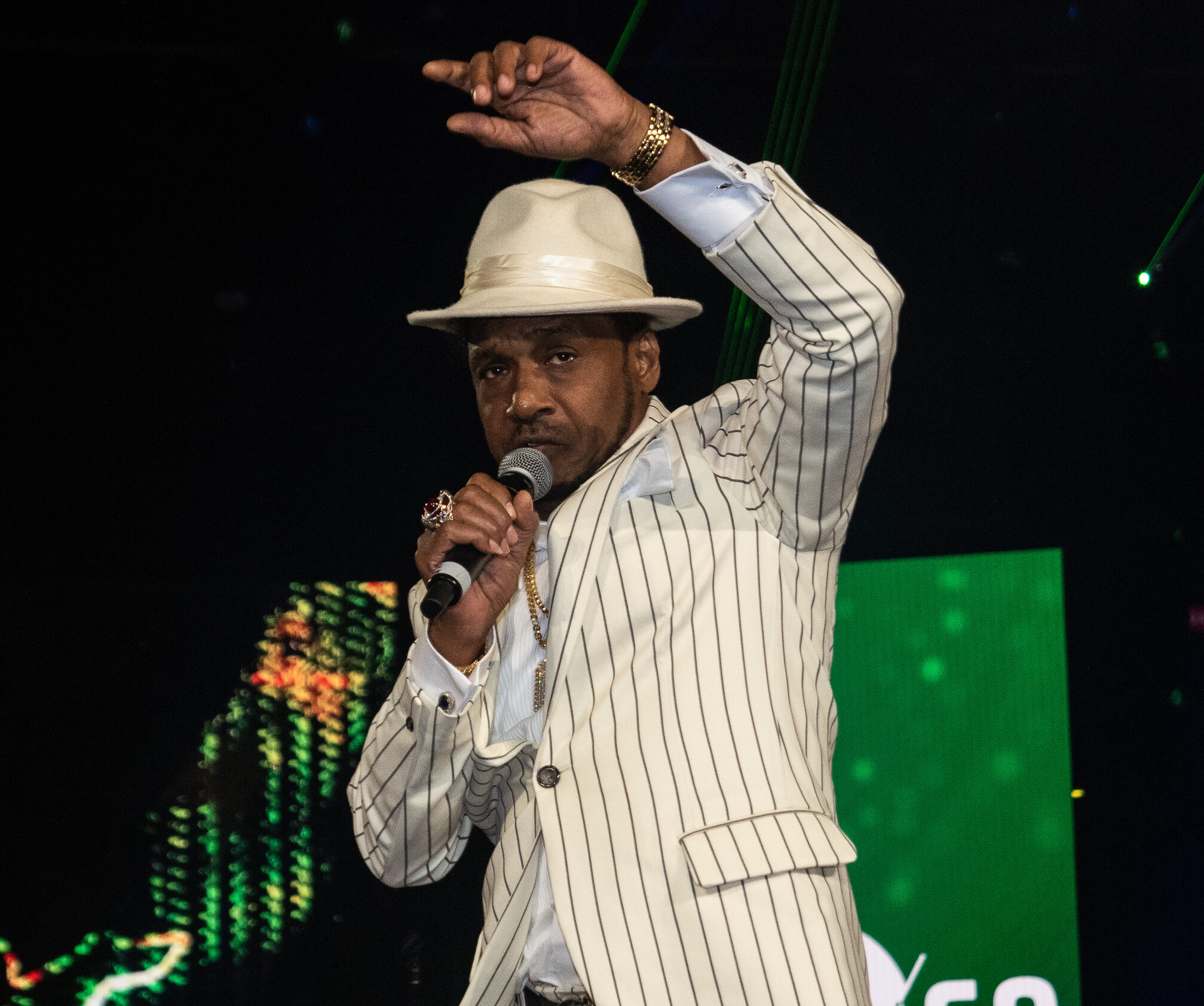
Since then, Cat has infrequently issued new music and performs sporadically, which gave even greater significance to his Barclay’s Center concert. The Don Dada stepped onto the Brooklyn stage dapperly attired in a retro-gangster white pin-striped suit, a white hat and dazzling gold jewelry. Cat tore through his hits, his razor-sharp flow now somewhat mellower yet still an awe-inspiring, defining voice of dancehall’s golden age. Backed by a four-piece band, Cat opened with ”Nuff Man A Dead”, his improvised lyrics cautioning Jamaican artists, including Bounty Killer and Beenie Man to ”insure your head.” Scatting the intro to ”Under Pressure” he addressed poverty, world leaders and nuclear power. While performing his 1985 hit ”Learn Fi Ride”, produced by King Jammy’s, he stopped the band, admonishing, ”all dem bloodclaat Jammy’s tune off key, it hard fi manage dem.” Cat utilized an assortment of Jamaican expletives to denounce Donald ”Rumple-Peel-Skin” Trump, blaming America’s 45th President for dividing the United States on his intro to the poignant ”Cry Fi Di Youth”. He declared himself leader of the Taliban then demanded ”every big pussy leader in the U.S. take my people off the bloodclaat reservations,” as the preamble to ”Come Down”. Rebounding from the curious spoken-word detours, the Wild Apache closed in great form with two of his biggest hits from ”Don Dada”: ”Ghetto Red Hot”, an incendiary statement on the brutality and scarcity of resources caused by Jamaica’s tribal politics and the album’s title track, where he asserts his preeminence through a series of blistering rhymes. ”Don Dada” was originally aimed at dancehall veteran Ninja Man following their tense 1991 clash at the (now defunct) Jamaica concert, Sting; thirty years on, the lyrics summarize Cat’s timeless approach: ”Mi lay dung pon di riddim like a two front fire and seckle inna di riddim like a bomb pon fire.”
Verzuz/Iconz co-founder Swizz Beats danced in front of the stage while watching Cat, as did Wyclef Jean, Busta Rhymes and KRS-One. Although he was the marquee act on the most high-profile reggae event held in New York City in recent years, Super Cat doesn’t see himself as an icon. ”Some people say, Dada, don’t you know the impact you have had? I say, all the years I am working with a band, or with a sound man, I am just working for the fans,” he reasoned. ”For a minute I worked with Columbia/Sony and I got a great amount of promotion, but away from that, I am just a simple person in reggae.”
King Addies has created a 30-minute Super Cat mix exclusively for RIDDIM:
https://mega.nz/file/iHBVRQ4Y#eS15bdYhdFj6dwROtzxKnFcMkRLjudQ36mpD0eTdKs0