

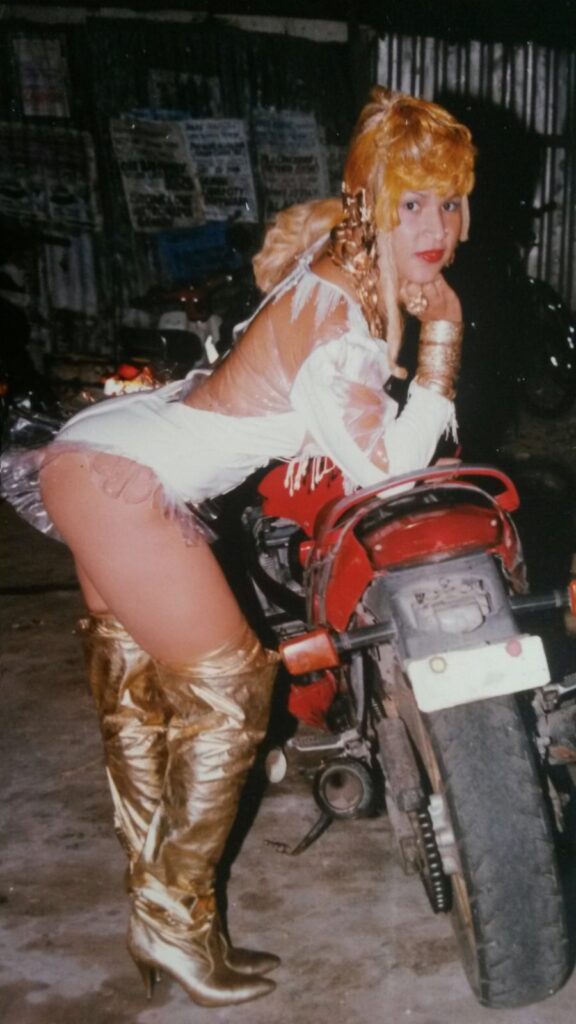
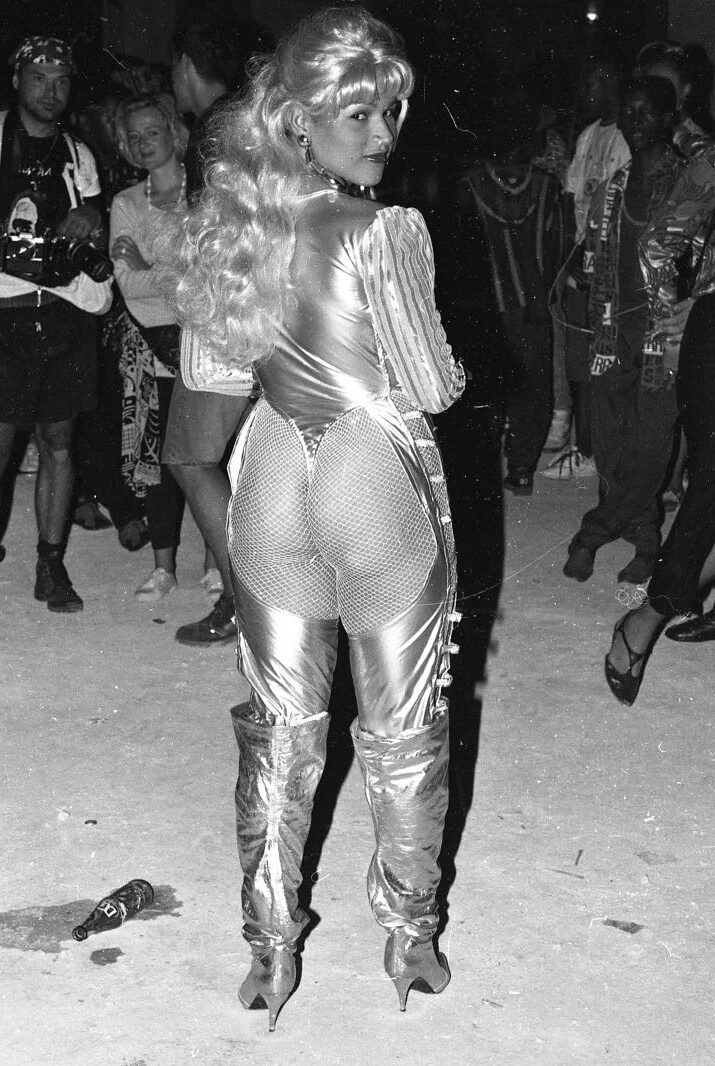
It is an iconic image: dressed in gold – balloon panties with ruffles, an off-the-shoulder, midriff-baring top with puffed sleeves, high-heeled over-the-knee boots, heavy jewellery – topped with a platinum-blonde wig, she dances the ”Butterfly” to Chaka Demus & Pliers’ ”Murder She Wrote.” She was the first Dancehall Queen, a sex symbol of the 1990s celebrated for her voluptuous curves. She carved out space for women in dancehall and shaped the aesthetic of artists from Lady Saw to Spice. Together with Beenie Man, she became the first dancehall power couple, constantly fuelling public fascination. More than 30 years after her coronation, Ellen Köhlings and Pete Lilly met the style icon.
Text: Ellen Köhlings & Pete Lilly /// Photos: Roy Sweetland
This article was first published in March 2025 (RIDDIM 02/2025).
Sometimes things simply fall into place. For years, we had wanted to interview Carlene Smith, the first Dancehall Queen, but somehow our paths never crossed – something else always seemed more urgent. Then, at the soft launch of Beenie Man’s seafood restaurant Simma, she was suddenly sitting at the next table, smiling at us. Phone numbers were exchanged within minutes, and just a few days later we found ourselves in the living room of her terraced house on a side street off Hope Road. Unexpectedly conventional in its overall feel, the space nonetheless bears her unmistakable dancehall signature, with plush furnishings and leopard-print accents throughout. From a shimmering oil portrait that covers almost an entire wall – as well as from Carlene’s T‑shirt – her sister Pinky, who passed away in 2023, gazes back at us.
Pinky played an important role in your life.
Yes, my sister Pinky introduced me to dancehall when I was about 13. Pinky was seven years older than me. She took me to House of Leo, that was my first dancehall. Remember, it was sound system, these huge mega boxes. Stone Love was the set at that time, at that particular dance at House of Leo. And here I come, ready for anything! And I just did not want to leave, there was just something about it that I fell in love with. So the first thing I recognized, I always remember because I always have to relive it, that’s the reason for remembering it, was that everybody was just doing what they felt like doing. There was a man beating on a can, there was somebody lighting up a big spliff, there was a man revving his bike, inside of the dancehall, mark you! The girls were dressed in their whole heap of frill clothes, one was bubbling with a guy and everybody was just being whoever it is that at the moment they felt like being and I was just in love. Pinky was dating Tiger at the time and took me to every dancehall stage show back then, you know, Roll Call, Sting, everywhere Tiger, performed. Because he was a mega star back then.
Stone Love was the set at that time, at that particular dance at House of Leo. And here I come, ready for anything! And I just did not want to leave, there was just something about it that I fell in love with.
You grew up in Kingston, right?
Yes, I was brought up in the Kingston 6 area, Liguanea, which is considered uptown. What that means is, you have a little more than the average person. Music initially didn’t play a significant role in my life. It’s hard to imagine today, but in the 1980s, dancehall hadn’t yet reached the average Jamaican household. So the music that I was brought up listening was Tom Jones, I love Tom Jones. Prince was my idol, yes, also liked Michael Jackson, but the person I said I was going to marry was Neil Diamond (laughs). Those where the music that was played in my house. At school fetes as a teenager I would perform, but it was to punk rock and disco. I never knew about dancehall then. My sister grew up differently. She grew with my mum, I and my other siblings grew with my stepdad. Pinky had a little more rebel side to her, she was simply irresistible, hardcore plus sweet and just outgoing.
Did your parents have any issue with you hanging out in the dancehalls at such a young age?
My stepfather didn’t mind, as long as I was with my big sister. So the good part of my parents was: My dad understood that I was different. I have nine sisters, and only one of them is younger than me. They follow a very straight path. One of my sisters entered Miss Jamaica World; she was Miss St. Catherine. I was different, which is me in my own right. As I said, I was into disco and punk rock. So my parents knew I was always off from my other siblings – and it was okay. My mother, in her entirety, too, was a rebel at heart. When she was 17, she rode the bull, it’s history, you can look it up. She took on every men. Only with 14, 15 years I found out that my mother was bipolar and schizophrenic. Only then I understood why she would leave us with my stepdad and was just gone. That was because of her mental issues.
According to reports, in 1986 you created a traffic jam at Half Way Tree with your outfit. Was this during your punk rock days?
No, I was always a seductive, sexy woman, girl and even child. I always thought of myself being sexy and people would say that, too. And being brought up among beautiful women, we would complement each other. I was the thicker one, my other sisters were skinny. They were always saying: ”Oh, you’re beautiful, you’re sexy!” I didn’t care about that, I knew I was a rebel somewhere in there. So my dad went to the bank in Halfway Tree, which is not the way it is now. And I’m in the back of the car, wearing two tube tops. I had on something else, but something in my head told me to take off my jeans and turn a top into a skirt. My dad’s gone into the bank and I stepped out of the car in a bustier and an extremely short miniskirt. I wanted to see what would happen. And it caused chaos! The cars came to a standstill in the middle of the street, and people stared at me as if I were an alien. I simply felt like it, without thinking much of it. When I saw the chaos I’d caused, I got nervous, slipped back into the car, and got dressed as if nothing had happened. My father didn’t know anything about it, but he was surprised shortly after when the radio mentioned a scantily clad woman who had caused a crowd at Half Way Tree (laughs).
I stepped out of the car in a bustier and an extremely short miniskirt. I wanted to see what would happen. And it caused chaos! The cars came to a standstill in the middle of the street, and people stared at me as if I were an alien.
People weren’t used to scanty fashion as they are today, which is why the outcry over your skimpy outfit was so intense.
I wouldn’t call it scanty, I use the word sexy. But no, women wore a lot of clothing. Frilly skirts, linen clothes, long plaza pants… I was allergic to it – ugh! Even if anybody wore a swimsuit or shorts, it would cause chaos. As young as I was, I knew I could take sex to another level. Because I saw the reactions that I would get when I was on the road with Pinky. Men would follow behind me, because of how I was dressed. But I had a thick skin, I didn’t care zero. And I was just smiling, but I would never answer them, because I knew who I was, I was very self-confident. And at the time I was even a virgin. I had never been with a man, it was never about that. I always did it just for myself. I think my African ancestors were strongly standing up in me. Where back when I was younger, I wish we could have all gone naked. I didn’t see it as selling sex or buying sex or trying to catch a man. Nope, I just saw it as how I felt.
As young as I was, I knew I could take sex to another level. Because I saw the reactions that I would get when I was on the road with Pinky. Men would follow behind me, because of how I was dressed. But I had a thick skin, I didn’t care zero. And I was just smiling, but I would never answer them, because I knew who I was, I was very self-confident.
That sounds like a kind of female empowerment.
I’ll tell you how that came now, when I decided that I want to make it into something to empower females. I start going to the different dances. So you’d have Rae Town, you’d have Harbour View, you’d have Torrington Bridge… With Pinky at my side, I know she could defend me. But mark you, I didn’t need defending. Jamaica has classism more than racism. And Jamaica has colorism more than racism. I look dark now because I’ve been trying to get my tan on. But back then I was extremely fair in color. And I do have beautiful, long, straight hair what Jamaicans call ”pretty hair.” Many even never thought I was Jamaican. I wasn’t dressed like a Jamaican, then I didn’t speak like one. When I talked to other women at a dance, I understood back then that a man was their way out of the inner city. Then I came into the dancehall and I recognized when I would go into a dance dressed sexy, I captured the dance. And I’m like, I haven’t danced, yet. And I started to understand where females belong in dancehall, cause there was no space. It’s a man dominated field. It’s hardcore, it’s rough. Remember, it’s emerged out of the ghettos. It is emerged out of poverty. It is emerged out of our poor sector of people. Dance halls emerged because people couldn’t afford to go into nightclubs, uptown or stage shows. They were trying to find a little way to entertain themselves and so they created these street performances, dances by just putting likkle music, play a likkle dominoes, drink some juice and that was their entertainment. Women wouldn’t have a chance in the dance hall. She would have to be going on like a man to get her space. So you’d have a stage show on and it’s 30 men and probably two women. And even if the women would have a number one songs they still can’t get booked on a stage show. And so I understood: you can’t compete with me as a man if I’m sexy. I couldn’t sing or deejay, I didn’t think that was my calling, mine was to set the trend for the dancers and the sexy women. And the men liked it, too: ”The gyal bad!” Only after that were artists like Lady Saw or Patra able to make their mark in the industry. I have a slang that I say: I’m selling sex but you can’t buy it. It means it’s for you to just admire me and leave it right there.
I understood: you can’t compete with me as a man if I’m sexy. I couldn’t sing or deejay, I didn’t think that was my calling, mine was to set the trend for the dancers and the sexy women. And the men liked it, too: ”The gyal bad!”
In 1992, you organized a so-called Fashion Clash, which today is regarded as the prototype for the later Dancehall Queen contests.
Dancehall versus Uptown. They started dubbing it, Downtown versus Uptown, because – again – dancehall only belongs to downtown, it was a downtown thing. But it was Dancehall versus Uptown. And I represented Dancehall. I can’t represent downtown, I’m not from downtown! So I was representing dancehall, that’s my culture, that’s my country! I’m always in defense of the inner city girls, I wanted to create something for them. So I went to the owner of the Cactus nightclub at the time, Andrew Williams, which later became Vivian Blake – leader of the notorious Shower Posse. I didn’t know that at the time. He was a nice man, he was a kind man. He would help a lot of people. No time did I see a badman or a don. No time did I see somebody that I’ve read things about in an evil manner. Anyway, he was really excited about my idea. The Uptown group included several top models, among them Miss Jamaica World, Erica Aquart. The dancehall group consisted of Pinky, me, and two other girls, Lana and Sharon. Anyways, on the night, which is April 12, 1992, Cactus had to close the door – the place ram! We first had to drink a little courage. And we teared up the place! We each walked with a girl, I was with Miss Jamaica World. They paired me with her. Everybody knew her and the whole island loved her. But when I would come out, me tear down the house based on what I was doing and how I was doing it – it was just awesome. She didn’t have a chance against me. She was Miss Jamaica beauty queen and I was Dancehall Queen. And hence this started Dancehall Queen, the competition. And we did like probably eight more and I won the eight of them. So when I came and started that, everybody started to follow the way I would dress. And it’s catching like wildfire, which was my intention. Then I was just… I did not grow, I just burst into stardom. There was absolutely nothing like me. I created dances like the famous ”Butterfly” before I was Dancehall Queen. So Bogle and I came through the ranks. But I bussed before Bogle.
When I came and started that, everybody started to follow the way I would dress. And it’s catching like wildfire, which was my intention. Then I was just… I did not grow, I just burst into stardom.
At the contest, was dance already at the forefront, or was it primarily about fashion?
It was a package of dressing, dancing, appearance, being different… And it was never about going on your head top and being sleazy or being acrobatic. It was about showing dancehall in all its fullness: the motion, the movements, the style, the imagery, the jewelry, the flawlessness – and that I had. Again though, I was about defending the women. Initially, I was hired for videos such as ‘Murder She Wrote’ by Chaka Demus & Pliers. But when I noticed that the other dancers beside me were fading into the background, I stepped back and let them take the spotlight. I don’t want to indulge in self‑praise, but at the time there was no one who looked like me. Everyone was beautiful in their own way, yet I simply stood out. The first thing I arranged visas for the Jamaican dancers so that the artists could take them on tour, rather than working with women from overseas. Because back then, the top artists would use overseas girls for their videos.
Where did your interest in fashion come from, that made you a trendsetter already as a teenager?
It was always about looking sexy, being sexy. And one of my idols was Marilyn Monroe, hence that blonde hair and the sexy twist. I mostly created my outfits myself. Let’s say I got these tights, I would cut the tights up. Take a scissors and just create something new. Don’t ask me where I got it from (laughs). And then everybody was like: ”Where you get that from?!” I would never wear whatever my parents gave me. I would always change it up. I just didn’t want to be like you, be like her – I wanted to be me. I did feel different and I wanted to look different. ”Alright, she look different! Which spaceship bring her back home?” So that was always in me, the clothes. At Sunsplash 1993, I had a mesh stocking on. So I wasn’t even naked, but they’ve never seen that. But it looked as if my bare butt could be seen, which is why the next day the newspapers referred to my ”peekaboo” moment. Now it’s common to wear things like this, but back then it never existed. Not even Madonna was wearing stuff like what I was wearing. Don’t ask me how and why, I just knew I had to make a statement and I usually do.
And dancehall was the perfect setting for it.
A lot of people get the time to shine in a space where they wouldn’t be seen elsewhere. They wouldn’t be able to show their little richness, their power, their strength. And dancehall allowed you. So you’d go into a dance hall and see men dress up, drinking the finest liquor and you think, oh my God, he must be rich. Just the way he looks and carries himself. He wouldn’t get that anywhere else but in a dance hall space, they become dons, Kings of their tribe. We no longer have that lifestyle, but this is really where it’s coming from. His great grandparents might have been a tribal leader and they don’t know how to exterminate that to understand that this is why I am the way I am. But that’s how they felt when they went in the space.
A lot of people get the time to shine in a space where they wouldn’t be seen elsewhere. They wouldn’t be able to show their little richness, their power, their strength. And dancehall allowed you.
Dancehall is considered a working-class culture, often looked down upon – more so back then than today. How did you experience it as an uptown girl?
I experienced that firsthand as well. A lot of people knew who my dad was, and they wanted to see me in Miss Jamaica World and not downtown in the dance hall. By the time of the first Fashion Clash, when Dancehall people started to realize that I wasn’t from dancehall. And they started to fight me out – something I created. I didn’t care, because remember, this wasn’t a meal ticket for me, this was a love. And when you love something, then you are willing to fight it till the end! So I was just in the middle, and I didn’t care. From 1993 onwards I started to tour. I took the flag of Jamaica, I took my culture to the weirdest places and I stood proud. I mashed up Cuba, I’ve been to Sardinia, to China, to Russia. It’s just Jamaicans really don’t like changes, they don’t like things that they don’t have control over. So you have to let them soak through and then they understand. Then uptown couldn’t bar me for long because I was the happening in Jamaica. If there is a word nuff, mi NUFF! And I knew marketing, I knew strategy and I knew to keep myself from you. So you’d never see me somewhere unless I’m paid to be there. It only sparked the interest in me. That’s how I became the face of many advertising campaigns, like our biggest furniture store Courts, Red Label Wine, the telephone company Cable & Wireless. And I was the face of Slam condoms when AIDS just started to kill our people. So it was needed. And men would buy a condom because my picture was on it, and that was the aim. People back then did big advertisements, huge billboards. You could not go and don’t see me on the TV. I’m on every commercial, I’m in every music video – I was nuff!
We still vividly remember the Courts billboards featuring you and Beenie Man.
I did four campaigns for Cours, each year they would do a different. So when Beenie Man’s ”Who Am I” became a huge hit – ”Sim Simma, who’s get the keys to my Bimma” – they were giving aways Bimmas that year. I told them that Beenie Man and I were dating, so you haffi use my boo!
Using a dancehall queen in a condom ad is a no-brainer. But making you the face of a furniture store was a real surprise back then.
Remember, it’s not like now. Nothing came into your face unless you went out to it. And dancehall was a nightlife. I’ve never gone naked. I was always just sexually seductively dressed to perform. So they understood that this girl have sense and she knows how to carry herself. In one of the Courts commercial I was wearing a gown, in another one a two-piece thing, next one I was in a space outfit. None of them was I ever in anything that was degrading or would mess with the brand. I’ve never had alcohol in my entire life, I’ve never smoked a spliff, a cigarette, or anything that you smoke. I am naturally high on life. The company wanted an international touch and I had that. I was performing on BET, I was the first dancehall female to dance on the Apollo Theater stage with Chaka Demus & Pliers. So Courts wasn’t stupid, they see that everything I was touching is going gold.
How did you first meet Beenie Man?
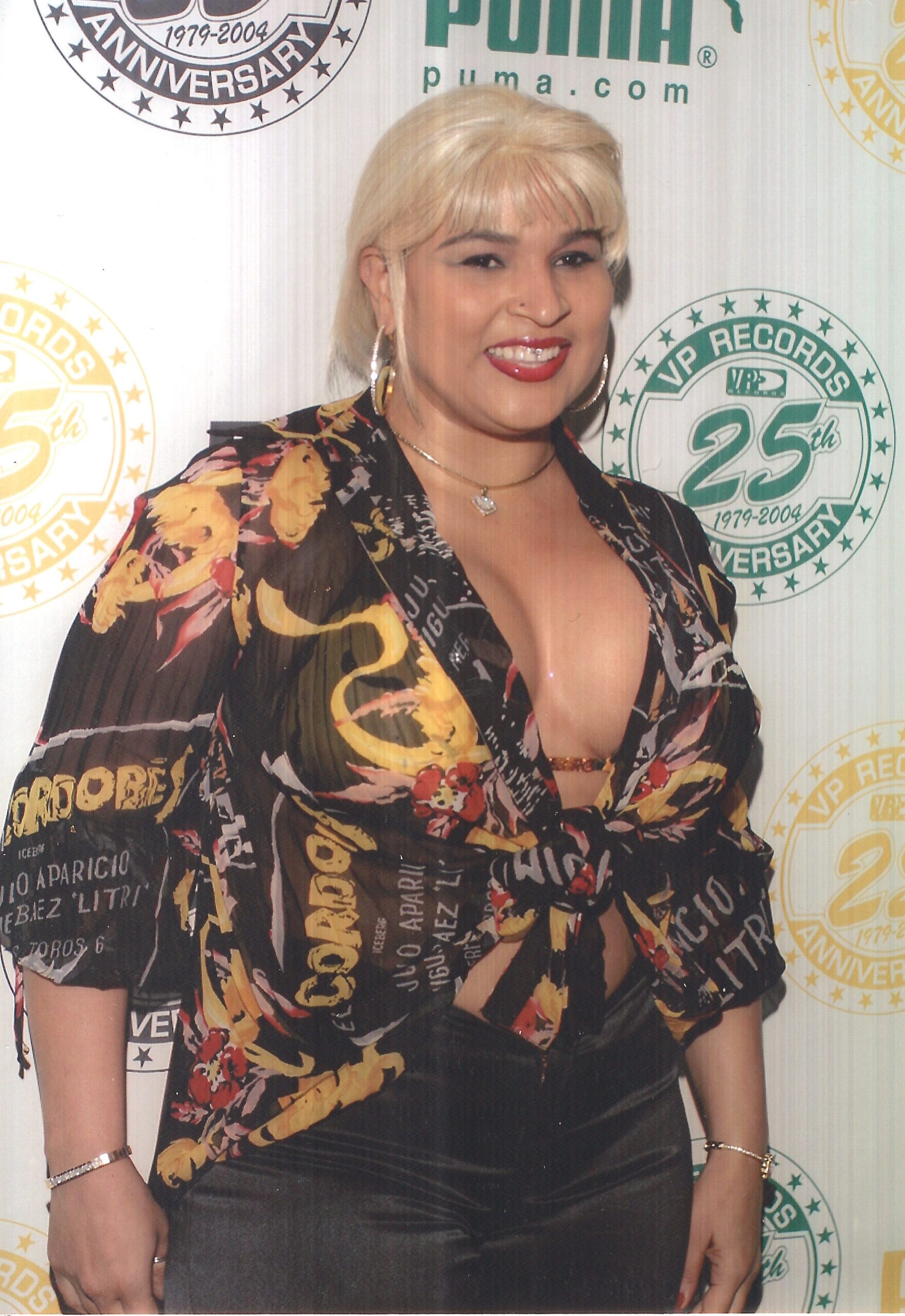
So here it is: I’m a sex symbol in Jamaica, the sexiest girl in Jamaica, dubbed, you know. Every man that’s available wants to be with me. And at the time I was dating an older man from uptown. I was dating my so-called kind. I did what was expected from me, but I wasn’t comfortable with this. I wanted to be at the heart of things. I met Beenie Man through Pinky. And he’s always taking set on me. But I didn’t want to mix my business with my personal life. But anyway, he was persistent, charming, handsome and everything that was nice. And I needed that, too. I knew I could help his career also, he wasn’t a mega star in 1994. He was just coming into it and very talented. He was an artist and a big artist too, but not in every society sector of the country. He mastered the dancehall, he mastered the ghetto, and he can take uptown people into dancehall as well. Same as I did. I dragged him into the uptown circle that I already had control of. Made them know him, so he could have grown into a different light. And Beenie Man, in turn, made sure I earned respect in the ghetto. He took me to Waterhouse the first time and some other ghettos and I loved it. Then I would go in and start mentoring young ladies, making them understand their worth, that a man shouldn’t be their meal ticket out. That they can dance–or do whatever it takes–to provide for themselves. My Ex was a rich man, Beenie Man was not and so that put a lot of pressure on him. Instead of looking at it like that: Every man wanted me, but I wasn’t with every man, I was with him. Beenie Man thought, he wasn’t good enough for me. It was a real pressure on the relationship. We were the first Dancehall couple, the first any kind of couple in this kind of light, two mega stars being together, it’s never happened, and they came at us. I could handle it, but I don’t think his surrounding helped him to handle it. So we broke up three times and we were just meant to be together again, we kept going back to each other. In the end I left him, cause I wanted to protect him, I wanted him to have his own shine, I wanted him to be him without any confusion or obstruction from me. And at the same time I didn’t think it was fair for me always putting back who I am to please his career. Cause he thought, my style of dress would harm his career. But I think, if you know it’s my job, it shouldn’t be an issue. Because I never dressed that way naturally. But people would come and say: ”Why you have your woman a wear that?!” And so it was hard for him.
I met Beenie Man through Pinky. And he’s always taking set on me. But I didn’t want to mix my business with my personal life. We were the first Dancehall couple. And they came at us. I could handle it, but I don’t think his surrounding helped him to handle it.
Yet you still seem to be friends. After all, we met you at his restaurant.
We have a daughter together, Crystal Davis. And in all essence of it, I’ve always been a backbone for him to let him know he has a safe haven. With all other relationships he will always have to doubt them: ”Are they with me because of who I am or because of Beenie Man?” It’s not the case with me and him. When we started to get to know each other, he never even had a car. So he’ll always have that little space to say I’m certain she was with me for who I am, not what I am. And, the caring loving person I am, always – we used to be best friends, we’re not anymore but we used to be. Cause not every woman would understand that. So sometimes it created problems in his relationships and so for him to have a good relationship cut me out. And I was fine in some aspect of it, you know? Just let’s be co-parenting and that he was.

Toward the end of the 90s, you gradually stepped out of the spotlight as other dancehall queens took center stage, placing greater emphasis on dance and acrobatics. What did you focus on during that time?
First, in 1999, I focused on becoming a mother after my daughter was born. But I never turned my back on dancehall. In 2003, I co-hosted the talk show ”Our Voices” with Lisa Hanna (former Miss World and now a PNP member of Jamaica’s parliament) bringing dancehall culture to television. For a while, I worked in radio before teaming up with Michael Dawson of Whirlwind Entertainment. He started House of Dancehall, right across from House of Leo. That was intentional from his point of view. Like myself Michael is a real defender of Dancehall. When COVID came, everything was shut down in entertainment. We got a blow, we had to close down House of Dancehall. So in the middle of COVID, 2021, Michael made some deal and got another place, a nightclub, which he called Mecca. So we carried over House of Dancehall to Mecca. When I got to working with Whirlwind and Michael Dawson and giving him all the ideas that I have, he has the ideas he has, we put them together and say, let’s do this! For years, I’ve been dreaming of organizing a Dancehall Road March, but I’ve had to postpone it again and again. At the end of 2023, I suddenly found myself forced to pull it together at the last minute. In 2018 my sister Pinky got real sick, she had cancer and I didn’t want to focus on anything else. I took care of her until the cancer was all over now. She died unfortunately 29th July 2023. Michael knew that was going to mess with me BIG. We already had planned the road march 2024. We did all the media stuff, everybody was anticipating it. But we were about to postpone it again, when I got hold of somebody’s going to do my road march in February, in Reggae Month, and was saying, this is the first ever to be done. And I have an ego problem when I knew I started something and nobody even came to me to say, okay, let’s do it together then. I got on the phone, this was November, and I called Michael Dawson and I said: No! This is NOT happening before me! They can have 100 after me. But we have to do the first! Unfortunately, due to the short notice and strict regulations, it didn’t grow as big as it could have with more time to prepare. Still, I had the entire dance scene behind me.
What are your thoughts on the many Japanese and European dancers who, after your heyday, began to populate–and sometimes win–Jamaican Dancehall Queen contests? Do you see this as cultural appropriation or as cultural appreciation?
Most definitely cultural appreciation. This was always my aim. When I went overseas, I didn’t go as Carlene only, I go as a representative of Dancehall, Jamaica’s culture. I spread that everywhere. I would go overseas and try and let them know, this is who we are. When other people started the competitions and took them up, remember I was the one who started it, I was disappointed in the way it was done. I wanted to show that dancehall culture has class, that it is tasteful. But later Dancehall Queen contests sometimes felt more like a go-go club. I also would have preferred to see Jamaican dancers and international competitors face off in separate contests, rather than having a Japanese dancer win a Jamaican competition. But I love that the culture spread and went as far as it did. I was pleased. My work was done, my sacrifice, my sweat, my tears and my pains made sense. I’m very content. It feels good to have started something that remains relevant more than 30 years later.
How do you view dancehall today compared to the 1990s?
What I never do is compare staff. Because it’s an evolution, we evolve, we rotate, and we grow. There’s things that’s happening that I definitely don’t like. I hate to see us losing us, losing our culture. And sometimes I feel as Jamaicans we want to follow the rest of the world. And we follow them too much, when we are so richly endowed with what we have. And I don’t like when our culture is watered down, when they’re infusing and growing something else out of what’s yours. It started with Ska, Rocksteady, then Reggae, then Dancehall. So we did emerge out of something into something, but what’s unique and good: It was all Jamaican. It was all our idea, it was all out of our culture. HipHop born out of dancehall! Today the younger generation is trying to infuse Afrobeats and Trap. We weren’t trying to adopt something else or somebody else’s idea or culture and infusing it. I don’t like that we’re trying to be somebody else, something else. Nah. We’re too unique and outstandingly original to be adopting something else.
It was all Jamaican. It was all our idea, it was all out of our culture. HipHop born out of dancehall! Today the younger generation is trying to infuse Afrobeats and Trap. We weren’t trying to adopt something else or somebody else’s idea or culture and infusing it. I don’t like that we’re trying to be somebody else, something else.
Looking back, do you feel you’ve received the respect and recognition you deserve?
I really think I have over the years. I don’t have all my trophies here. There are several, they’re in the box because I only moved here a couple months. And in the Jamaica 100, the time capsule, it’s 100 unique and contributing people to our country, I’m in it. When I’m gone that will come out, because it’s 100 years after Independence. So I think nobody owes me anything. My achievements come from when I’m being called from Greece, Poland or Finland to come and do a lecture. My legacy will live past me, the Butterfly dance, 33 years later it’s still being done, it’s still being taught through other persons. I’ve left my mark, I didn’t come here as a regular person and I surely never left as a regular person. I will always be the first Dancehall Queen. And no one can take that away from me.