



He is particular when it comes to his art – an enigma. After keeping a low profile for five years, releasing scarcely anything under his own name and playing only a handful of shows, he suddenly drops an album with almost no warning: a record that pays homage to reggae tradition, stands shoulder to shoulder with the greats, and still manages to rethink the genre. But instead of promoting it to the hilt, he grants almost no interviews, doesn’t go on tour, and otherwise continues to keep his distance from the public eye. To give ”Exile” the appreciation it deserves, Ellen Köhlings and Pete Lilly combed through past interviews and subjected Chronixx’s songs to a close reading.
Text: Ellen Köhlings & Pete Lilly /// Photos: William Richards
”Music is not a man made thing. It wasn’t a man who bring music into this dimension. It’s a God given thing. It’s like your inspiration, it’s like sight. Me know music is just another sense.” (Chronixx 2015)
When The Tides Were So High And Strong
Not long ago, the lush landscape here glowed in vibrant green. Brightly painted wooden huts added splashes of colour, and even the smallest villages buzzed with activity. Now, as far as the eye can see, stretches a grey-brown wasteland littered with bare branches, toppled power poles, uprooted trees, roofs torn off, walls collapsed, windows shattered, household belongings scattered about… Desolate scenes, underscored by consoling words and healing music.
Reels like these, documenting the catastrophe, move from one Chronixx track to the next. The rapid pulse of the digital feed is slowed by the pull of an analogue production and a familiar voice – one that hasn’t been this present in years, yet now seems to be the lifeline an entire nation is grasping for. The apocalyptic scale of the devastation, the sheer suffering of the people, cries out for a counterbalance.
”When the tides were so high and strong
You gave me shelter from the rain
On an open and raging sea
You rescued me”
(”Hurricane”)
On October 28, the Category 5 monster Melissa made landfall on Jamaica’s south coast with extreme wind speeds of over 300 kilometers per hour and a minimum central pressure of barely 900 hectopascals, making it one of the strongest hurricanes ever recorded in the Atlantic. Two and a half weeks earlier, on October 10 – his 33rd birthday – Chronixx had released ”Exile,” his second album, a 17-track follow-up to his debut ”Chronology”. Chronixx seems to possess a prophetic gift: unwittingly, he has created the healing soundtrack to the most massive, human-made natural disaster ever to strike Jamaica. His prayerful track ”Hurricane” plays on an endless loop across Instagram feeds. Interspersed are ”Resilient,” a call to inner strength wrapped in a love song, the survival anthem ”Survivor,” and the uplifting, hope-bearing ”Keep On Rising.”
”And you inspired the best in me
So I could stand for what I believe
Gave me peace that surpasseth all
Eternity”
(”Hurricane”)
There is something prophetic even in the album cover, if you follow the singer’s far-sighted gaze into the distance. His grainy profile occupies half of the earth-toned artwork. To the left, a dirt road; above it, a sunset beneath a clouded sky – no title, no artist name, nothing to distract. In keeping with the music, the photograph, too, carries a sense of calm.
Before the release, Chronixx said that ”Exile” was made for Jamaica. At the time, no one on the island could have imagined just how deeply they would come to need the album’s soothing, uplifting, and poetic words, or its warmly comforting analogue sound. The Jamaican photographer Sabriya Simon wrote the following about the album in a commentary on Instagram: ”May many now overstand that this is partly what sacred devotion and sacred service – to oneSelf, to family, to the earth, to love, to purpose and to the Almighty – look, sound and feel like – all in divine time. May the light medicine of this offering be received in a mighty way by all who need it.” Right now many seem to need this medicine. Kabaka Pyramid calls ”Exile” ”music for a true vibrational shift, for souls and not the industry.” Royal Blu attests that Chronixx‘ music makes God smile.
Nah Follow Nobody
We recognized Chronixx as an exceptional talent early on. First releases such as ”Start A Fyah,” ”Odd Ras,” ”They Don’t Know,” and ”Here Comes Trouble” were instant hits. The Major Lazer mixtape ”Start A Fyah,” curated by Walshy Fire, was our personal album of the year in 2013. At a 2014 performance commemorating Little Joe – the founder of the Jah Ova Evil movement, through which Chronixx first became a singer – we had the distinct feeling we were witnessing a superstar in the making. And we were clearly not alone: the interest shown by figures such as Chris Blackwell, Mick Jagger, and American late-night host Jimmy Fallon spoke volumes. The first offered him a publishing deal early on. The second, on his own birthday in 2014, made a point of catching a Chronixx concert in New York’s Central Park. The third invited him onto his show three times – in 2014, 2017, and 2020. Comparisons to Bob Marley were not long in coming. When we celebrated his debut ”Chronology” as an ”album of the century” in RIDDIM in 2017, we were widely criticized – yet by now it’s beyond dispute that the record raised the bar for modern reggae productions to a level that only few have reached since.
But from the very beginning, Chronixx resisted commercial success. When Jamaica’s Ministry of Culture hosted the mini-festival ”Arts In The Park” in Kingston’s Hope Gardens in 2013 – an event designed to showcase promising acts like Protoje, Raging Fyah, and Nomaddz to representatives of U.S. record labels – Chronixx delivered what may have been the most aggressive performance of his career. He kicked out, issued unmistakable declarations, and rapped more than he sang. He made it abundantly clear that he had no interest in being signed by anyone in attendance.
In an interview conducted just two months later, ahead of his concert at Wuppertal’s U‑Club, he vented his frustration with the music industry and the expectations placed upon him. ”Music is pure, the industry is corrupt, it’s demonic. It is negative, because if all that you exult is negative, that mean you are negative. Me bun dem industry, man, me blaze it. Right now if I could kill some industry people me do it. Selassie I know! Ah Jah really manifest through me and make me into a better youth, too and lighten me heart against certain people. Because the music nah go reach far with certain people walking among us. Me no signed to no label. No label man can bring no contract and gi’ me, me spit pon it. Me nah follow nobody! The only people who me take argument from is musician. My friends are musicians, my family are musicians.” He wasted no time offering the rationale behind his stance: ”It is said that Chronixx is hype and dem put me up on a pedastal now fi somebody start shoot arrows off ah me. But hear wha gwaan, me no deh pon nobody pedestal neither. So it’s an empty pedestal dem have up deh. Them can call me up for a medal and me not going for it. Because I don’t want no medal, no trophy from Babylon!”
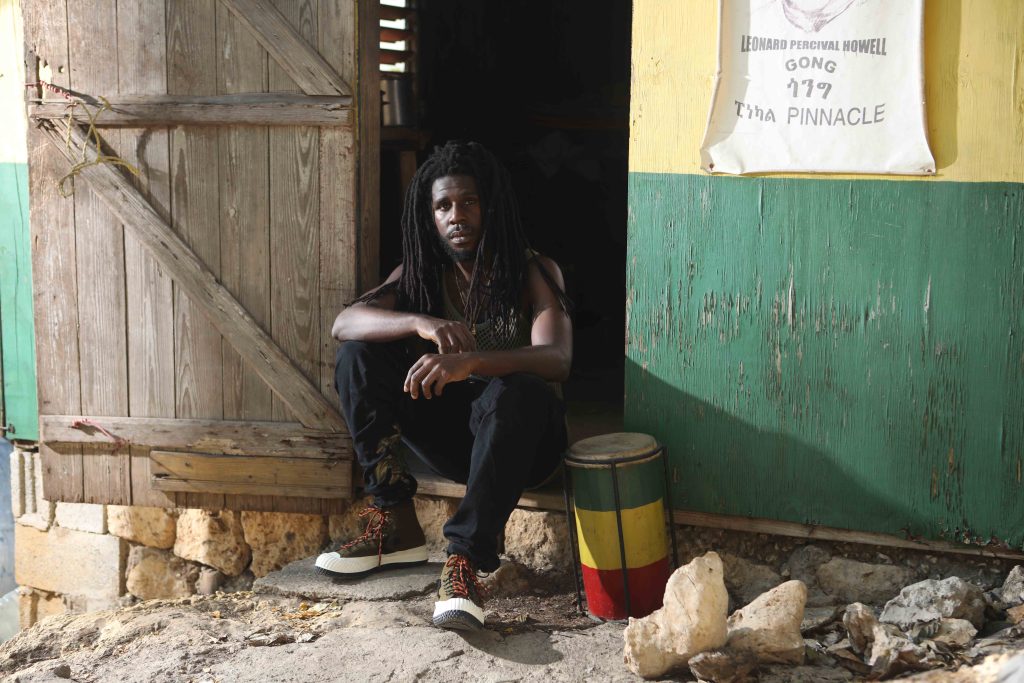
Chronixx has never sought the spotlight. When Rihanna approached him for a collaboration on her long-promised but never-released reggae album, he reportedly – according to a member of his team at the time – politely declined, saying he wouldn’t help a millionaire sell lingerie. The notion that he might one day withdraw from public life was therefore embedded in him from early on.
Shortly after the start of the pandemic, he pulled his announced second album, ”Dela Splash” – extensively discussed in RIDDIM 02/20 – and shifted his focus to his still-new role as a father. The management team of close friends that had taken care of him from the very beginning and grown alongside his career dissolved, as did the ZincFence Band, with whom Chronixx had spent eight years touring the world. Those close to him say he never stopped making music. He is said to have recorded multiple albums, yet only a handful of features and his work with SAULT – projects that don’t even bear his name – have surfaced. More on that later. Over the past five years, he has played scarcely more than a handful of shows.
See at the end of this story:
Ten Big Tunes Featuring Chronixx That You May Never Have Heard Of
Otherwise, Chronixx appeared only through his passion project, the JamCoders Summer Camp. Launched and funded by him in 2022, it is a workshop series at the University of the West Indies that teaches pupils and university students how to code and introduces them to algorithms. Great emphasis is placed on critical thinking.
”Coming with dem science with dem technology, that’s fine
Cause woie Jah Jah children have science and technology long time well
Coming with them false doctrines
Them mis-education, well that’s fine
Cause woie Jah Jah children have religion and education long time”
(”Don’t Be Afraid”)
Movement of Jah People
The album title ”Exile” inevitably calls to mind Chronixx’s apparent ”inward emigration” over the past five years. As he said on David Rodigan’s BBC 1Xtra radio show: ”I felt like there was a point when the whole world kind of withdrew. I felt like I had to extend my thing. And my main experience was pursuing music, trying to become the artist I always wanted to become. And that became so crucial and important to me to a point where I just couldn’t wait anymore. I was like I need to go now and practice, go into the studio and start reading, studying everything about even my music. Because then I would come to London and everybody knew everything about Reggae music, except us, you know, as the younger ones. So I’m just like, we can’t continue like this, we have to be part of the conversation genuinely. Not just because we are Jamaican or because we look the way we look or we say the thing that we say. But we have actually be conversation ready.”
The singer makes it clear that the album title ”Exile” does not refer to himself, but to the five years between 1936 and 1941 that Ethiopian Emperor Haile Selassie I spent in exile in Bath, England, coordinating resistance to Mussolini’s invasion of his country. One way or another, the title inevitably invites comparison with Bob Marley’s millennial classic ”Exodus”, whose name rings strikingly similar. On one level, that album can be read through the lens of Bob’s own story – his exile in England after the assassination attempt on him in December 1976. On another, ”Exodus” speaks to something larger: the repatriation of the descendants of enslaved Africans to the Motherland, mirroring the departure of the Israelites from Egypt toward the Promised Land.
Like ”Natural Mystic”, the opening track of ”Exodus”, the title track ”Exile” emerges only gradually from a distance, swelling slowly before revealing its full force. Further obvious parallels between the two albums are of a sonic nature. Consider, for instance, the harmonic, rhythmic, and melodic kinship between Chronixx’s ”I Know What You Feelin’” and ”Waiting in Vain”. ”Keep On Rising” seems directly inspired by the unmistakable Barrett brothers’ one-drop groove heard in ”So Much Things to Say”. Likewise, ”I and I” feels musically indebted to ”Guiltiness”. Yet despite the unmistakable influence of ”Exodus” on ”Exile”, Chronixx never relinquishes his own identity. He has internalised the reggae tradition of the 1970s and shaped something entirely his own from it. Rather than relying on samples or cover versions, he sustains a spirit – carrying it forward and pulling it into the present.
As early as 2016, Chronixx impressed upon us – straight into the recorder – the necessity of preserving reggae for future generations, while adding that not everyone was destined to take on that task: ”Don’t make nobody fool you, ah no every man can do Reggae. Reggae is a soul music. And ah no every man have the soul. But for who find themselves blessed with that soul, have to preserve that music.”
At the time, he did not yet feel the call to fully embrace the task. He flirted with contemporary dancehall and various pop influences. His never-released album ”Dela Splash” was still marked by dark trap scapes.
Now Chronixx steps fully into that mantle. ”Exile” resonates with echoes not only of Bob Marley but of roots legends like Burning Spear – ”Don’t Be Afraid” unfurls with regal fanfares over a relentless steppers pulse. Gregory Isaacs’ seductive Lover’s Rock resonates in ”Sweet Argument”. The airy instrumental of ”Scheming” recalls the effortless grace of a Studio One session by the Soul Vendors, while the organ on ”Family First” feels as though Jackie Mittoo himself were tracing its keys. Even where the album’s connections to reggae history are less obvious, ”Exile” breathes the spirit and soul of the genre’s golden era.
Returning once more to the comparison with ”Exodus”: like Chronixx’s album, Marley’s London-recorded work sounded markedly different from Jamaican reggae when it was released in 1977. ”Exile”, too, marks a break while honouring tradition, setting itself apart from contemporary trends. In a manner reminiscent of Marley’s playful experimentation with blues, soul, and British rock, Chronixx flirts with classic Black music styles – gospel, soul, funk, and disco – and in the deeply moving ”Hurricane”, even with the folk of the American civil rights movement as embodied by Bob Dylan. All of these are roots-based genres, which, as with the King of Reggae, ultimately bow to a Caribbean offbeat. The paradox is that ”Exile”, despite its nods to nostalgia, sounds utterly fresh – if nothing else, as a welcome counterpoint to today’s music, dominated by algorithms, artificial intelligence, and the demands of streaming platforms.

Anuh Everybody A Go Like We
Whereas ”Chronology”, with tracks like ”Skankin’ Sweet”, ”Smile Jamaica”, or ”Likes”, still sounded radio-friendly, polished, and clearly structured – carrying a certain pop appeal – Chronixx no longer concerns himself with such conventions. ”Exile” is a letting go of norms, a pushback against the strategies of the music industry, a deliberate refusal to be commodified. It is a musical stream of consciousness, a consciously quiet and introspective, yet no less resolute, manifesto of personal freedom – raw and tender at once. Meeting expectations is now less than ever his aim, which perhaps explains, alongside the widespread acclaim, some of the resistance the album has encountered.
Loosened, unconventional – or at least acquired-taste – song structures, fluctuations in volume, tape hiss, ambient noise, and room acoustics challenge listening habits and can at times cause irritation. Some listeners may miss obvious hits. The songs sometimes feel unfinished or sketch-like, the production rough, imperfect. Yet it is precisely these qualities that give the album its distinctive authenticity, its vintage charm, a sense of immediacy, and pull us deep into the world of its creator. The album’s producer, Londoner Dean Josiah Cover, aka Inflo, likely played a significant role in shaping its character.
Start A Universal Love Trend
Inflo, until now virtually unknown in the reggae cosmos, is primarily recognized for his work with Little Simz, Adele, and his wife Cleo Sol, who is also involved in his enigmatic music collective SAULT (an acronym for ”Start A Universal Love Trend”). The man seems to fear no musical boundaries. His range spans British indie rock, bombastic hip-hop production, vintage soul, raw punk, choral gospel, classical music, orchestral broadband scores, and even musical and operetta interludes. Essentially, he covers the entire spectrum of Black music – and then some. This has earned him comparisons to a young Quincy Jones. R&B super-producer Jimmy Jam says that Inflo turns everything he touches into the best music possible. Adele recalls marathon five-hour ”therapy sessions” with him, in which he drew out feelings she didn’t know she had, transforming them into some of her most intense songs. Before Little Simz ended their long-standing friendship over financial disputes earlier this year and has since communicated with him only via lawyers, she described their musical collaboration as a fearless exchange, a pushing of boundaries rooted in profound mutual trust.
Inflo’s ethos is perhaps most evident in SAULT, a collective of extraordinarily talented artists and musicians whose names and faces remain largely hidden. Unless you study the credits closely, you wouldn’t know that the vocals come from Cleo Sol, Little Simz, Michael Kiwanuka – or Chronixx himself. In November 2022, SAULT dropped five radically different albums in a single day – ”11”, ”Untitled (God)”, ”Earth”, ”AIIR”, and ”Today & Tomorrow” – a brilliant move to undermine marketability and defy the machinations of the music industry. Rather than explaining themselves in interviews, Inflo lets the music speak, and it speaks clearly. The 2020 album ”Untitled (Black Is)”, whose minimal cover features a Black Power fist on a black background, became a soundtrack for the Black Lives Matter movement. Blackness – as a confident, unapologetic, yet non-aggressive statement, a form of empowerment against rampant, dangerous white supremacy – is central to the work of SAULT, Inflo, and Chronixx alike. The Jamaican first appeared in connection with SAULT on ”Angel”, a ten-minute blues-gospel-spoken-word opus from October 2022, reflecting on the life and death of a soul rebel in the wake of George Floyd’s murder. The track is divided into seemingly disparate musical segments, yet it flows as a cohesive narrative. Since then, Chronixx is featured on nearly every SAULT release. On the punk-infused ”Money”, he sounds more like the Dead Kennedys than Bob Marley. In keeping with the collective’s ethos, the singer remained circumspect in his comments to Rodigan: ”Well, SAULT is the music of SAULT. So anyone who wants to know about SAULT, they just should go and listen to their tunes.”
In the same breath, he says of his own album: ”All the creatives, who played on my album – Cleo Sol, my bredrin Inflo, Kelissa, my father Chronical, all the musicians – it was a deep spiritual experience for all of us, where our faith was tested. Everything was tested. So for us, we have already gotten what we wanted from the music. So the next step was to make it available for people to listen. We always knew that this was a music of service. After ‘Chronology’ was fully written on Fruity Loop, I knew that this step that we was taking was a step upwards, so that we could do music for service, which mean it wasn’t about our style, our capabilities, our talents, it was just about us showing up with the faith and knowing that we are working for Jah fe get instruction and guidance. While we were making this music all of us got tested. There was one time our engineer, she gave birth in the middle of the production, being nine months pregnant, working on music. She was just so into it, and livicated to the cause and to the mission – like all of us were.”
Upon the release of ”Never Give Up” in April 2022 – the first joint release by the artist and producer, later remastered for ”Exile” – Inflo wrote on Instagram about Chronixx: ”Thanks to the real General for introducing me to making music with family in the room, I feel blessed to come into your world, working with you is healing.”
After their joint concert in London in August this year, he also took to Instagram, writing: ”Chronixx – the prophet I’m so inspired by you and your integrity and presence, your commitment to family and music. Your journey is spiritual, and anyone who is around you becomes a better human. Thank you for being here.”
God’s Love, Resilient
Back in our first interview in early 2013, the then 19-year-old Chronixx, sporting short stubby dreadlocks, explained to us the role of ”worship leader” that he had assumed at the age of 13 in the Lighthouse Assembly Church of God in De La Vega City, a neighbourhood of Spanish Town. ”A worship-leader is a different level now from choir. Because a worship-leader would start the service. And that role now was assigned to me at a very young age. And to be a worship-leader in church, you had to hold a certain level of meditation. Because you lead people into worship. It is the same with reggae music, you know? Bob Marley had to hold a certain level of meditation, because he was leading people out of what they’re in into something new. So that principle, I bring it over into reggae music, because you don’t just go and sing to people and expect people to feel good, you know? You have to go up there with a spirit and a sensation. So whenever I hold the mic, I know that somebody in the audience came here under a certain vibe and I can’t make them go home under that same vibe. I have to free up them spirit a likkle.”
”If I ever forget to hold your hand
I know it can feel like forever we’ve been struggling
Jah love is our strength
Together we’re resilient”
(”Resilient”)
Stretching over seven minutes and twenty seconds, ”Resilient” is a heartfelt testament to a man’s profound love for a woman – a love whose power and perseverance are rooted in the unconditional love of God for humankind.
A solitary, tenderly plucked acoustic guitar barely rises above the background hiss. A whispered, emotive ”Huhuhuhuhu” joins in, and then Chronixx begins, as if spontaneously by a campfire, to declare his love. About a third of the way in, the female harmonies gradually swell, and Chronixx adds more intensity to his voice before, halfway through, ceding much of the stage to the backing singers – ”God’s love resilient,” repeated endlessly like a mantra. At 5:30, the guitar falls silent. The now fervent choir erupts into an intense, increasingly unrestrained canon, accompanied only by enthusiastic clapping. We are in a church, seated right in the midst of it. The atmosphere escalates to ecstasy, before the sudden silence hurls us back into the here and now.

According to Chronixx, ”Resilient” was the first song he recorded for the album. It is also one of the tracks that has drawn criticism for sounding like unmastered demo recordings – a charge Chronixx had already addressed in a 2015 interview in London, when we spoke to him about the poor audio quality of some reggae productions. ”I wouldn’t play music based pon the mastering. I would play music that people love. That’s the thing with Reggae. When you go ah dancehall some song sound loud and then the next one not so loud, some mastered, some unmastered. But it nice, it have a vibe. Good harmonies, good melodies, good words, good music, good musicianship that to me is more important than the mixing to tell you the truth. Because by mixing the song, you ah risk spoiling the vibe. Me just no bother take the risk. But hear what me do: Sometime me just no bother mix it (laughs). Cause sometimes the guitar by itself, it sounds so nice, it record in the right room through the right amp and you won’t go drown it out with too much reverb. Nuff of Bob Marley music dem, you listen the vocals dry. You listen to some Burning Spear, is nutting dere pon di guitar. I have a very good mic, very close to my bedroom. So if in the morning a song come to you and that demo is good enough, I don’t need to go and record it in a better studio. So if the demo is nice, you keep it.”
Mi And Mi Baby Mama Guh A Market
When we arranged to meet Chronixx for an interview back then, he made us wait because he needed to do some grocery shopping – he was staying with an aunt rather than in a hotel and was taking care of his own meals. Two hours later, he arrived at the agreed meeting spot and apologized, explaining that a supermarket trip always takes him a little longer, as he reads the ingredients of every product and never buys anything containing preservatives. Chronixx has therefore long placed great importance on healthy eating. During his Capture Land tour across Jamaica that same year, only Ital food was served, and no alcohol was offered.
After ”Plant It” and ”Spirulina”, ”Market” once again turns its attention to what we put into our bodies – this time wrapped in cool storytelling in classic ’80s dancehall style, peppered with digressions and asides, all delivered like a freestyle. Over a laid-back, bouncing funk instrumental from The Meters, Chronixx sets the scene: he and his baby mother are heading to the market, bustling like a Stone Love dance. In classic deejay style, he lists everything that goes into the shopping basket – with the Empress always having the final say. He laments the high price of callaloo, excused by a certain Miss Marjorie as a result of inflation – times are hard. Chronixx inserts a brief economic commentary before moving into a spoken-word section, equating struggling farmers with the original deejays and name-checking artists like Nicodemus, Burro Banton, Early B, and Supercat. He prefaces this with a description of a performance scenario now mostly found at old-school dances: He sets the scene like an old-school dance: deejays chatting until dawn, never running out of lyrics. ”Market” is built in this same endless-flow spirit – the tune could keep going for a hundred more verses and still demand a forward.
Chronixx’s father, Selvin McNaughton – better known as Chronicle, an ’80s and ’90s dancehall singer, whose song ”Sweet Argument” Chronixx now covers – told the Jamaican newspaper The Gleaner shortly after the release of ”Exile” that he had taken his son to the studio at just three months old. ”I carry two nipple bottles, all three sometimes, cause him love him food. I just hold him in my hand and ride with him on the bicycle and go a studio. Dirtsman and Gary Minott… a him two godfather dem deh. I teach him the music from when him don’t even understand the music… but mi just mek sure that it soak inna him.” Practically with his mother’s milk.
”Ribbit!” In the second half of the song, Chronixx launches into a full-scale critique. He calls out companies like Monsanto, who patent genetically modified seeds, ruining farmers and even rendering their harvests inedible for Chronixx. Instead, he champions herbal teas and what nature provides at his doorstep: soursop, lychee, breadfruit, limes… He celebrates Ital cuisine and concludes with a reminder that the best things in life are free – ”gluten free, dairy free.” Humor, wisdom, and activism collide seamlessly, a testament to a musical lineage steeped in conscience and care.
Family First
It was just before sunset on a February day in 2020 when we last encountered Chronixx. He stood on the terrace of Skyline Levels high above Kingston, with his wife Kelissa and their daughter, not yet a year old, gazing at the city bathed in red-orange light, waiting for the sun to sink into the sea beyond. A rare privilege, to witness such a private moment. A moment, he told us then, that the young family had turned into an evening ritual whenever the singer wasn’t on tour. He held his daughter in his arms, tenderly explaining the natural sounds that reached a crescendo at dusk. He imitated bird calls and chirping crickets – sounds he had previously told us inspired his music. On ”Exile”, they appear unfiltered in ”Hurricane”. Shortly after this encounter, a virus triggered a worldwide lockdown, which at least gave Chronixx the chance to fully savor such intimate moments with his loved ones.
Five years later, the song ”Family First” seems to answer the question of why Chronixx withdrew from the public eye. Over a lightly swinging lo-fi early-reggae riddim with a vintage sound, he celebrates family as the foundation of a thriving community. It is precisely through its beautiful imperfection that the song radiates a tenderness freeing its creator from any hint of conservatism. Family here is not meant in the Christian-democratic sense of a societal nucleus. Chronixx’s understanding of family extends beyond father, mother, and child; his focus is on care for one another and the love shared, rather than on blood ties.
Love Is On The Mountain
One could undertake a close reading of every single track on the album – we could go on forever. From ”Exile” to ”Love Is On The Mountain”, it has left us positively overwhelmed, even though it is anything but intrusive. Directed at his fellow Jamaicans yet expressed in a universal language, it draws another parallel to Bob Marley. Lyrically, Chronixx deliberately holds back. This is particularly evident in the nine-minute ”Genesis”, which, despite its title brimming with associations, contains barely 80 words. The other songs are similarly sparing, never feeling overstuffed. The album is like an oasis of calm in an era of information overload. Only ”Market,” with its nod to a dancehall freestyle, works with several longer verses. Otherwise, the tracks rely primarily on repetition, creating memorable patterns that function as affirmations. This rhetorical device is employed so skillfully and so frequently that it becomes an art form in itself. In their spareness and repetition, the songs resemble prayers – invocations to the Most High. In general, the lyrics leave plenty of room to breathe. Like the music, they draw their strength from simplicity, yet their messages remain complex and layered.
”Your love is like music to my soul
Our journey is like poetry
Love is our destiny”
(”Genesis”)
Even before its release, Chronixx was hailed as reggae’s saviour. That this mission is close to his heart is evident to anyone paying attention. ”Exile” radiates a deep love for the genre, reflected most clearly in his meticulous engagement with its history and traditions. Yet Chronixx is driven not only by his devotion to reggae and Black music as a whole, but by love in all its forms – interpersonal, unconditional, universal – a connection to and a means of communication with Jah. With ”Exile”, he places himself in Jah’s service: Music for Service.
”Exile” has been released digitally and on vinyl via Inflo’s label, Forever Living Originals.
Ten Big Tunes Featuring Chronixx That You May Never Have Heard Of
Selected by Adrian Nowak
01 Estelle & Chronixx – ”Queen” (2018)
Estelle: ”Meeting Chronixx was really cool. It’s like a young Bob Marley or a young Dennis Brown coming back. When he enters a room, you feel his presence, his energy. He’s still so young, and he’s sure to achieve great things on his journey. I like that he stands up for what he sings about – and his voice is unmistakable.”
03 Mr Eazi & Chronixx – ”She Loves Me” (2018)
Back to Mama Africa – Afrobeats Style
Mr Eazi: ”My former tour bus driver always listened to Chronixx on the road. When he drove for Chronixx, he played my songs. He also put me in touch with Chronixx and we made ”She Loves Me” together. I then flew to Jamaica and we performed together at Reggae Sumfest. It was my birthday that day. It was a special moment for me. As a teenager, I always heard a lot about Jamaica. And then I got to perform there with a huge talent like Chronixx. He’s a wise soul, almost enlightened. It was a great honor and my best birthday present ever.”
03 Little Simz & Chronixx – ”Wounds” (2019)
Double-time rap from the UK rap goddess meets dark, melancholic vocals.
04 Free Nationals & Chronixx – ”Eternal Light” (2019)
The band of US singer Anderson Paak plays a booming beat with a fat bassline. Chronixx raves about the ”Good Vibrations YEAH.”
05 Young T & Bugsey & Chronixx – ”Blessings” (2022)
The UK rappers ingeniously flip an old-school highlife sample by Ghanaian artist K. Frimpong, crowned by an uplifting Chronixx chorus: ”Oh, Jah blessing is forever.”
06 SAULT – ”Angel” (2022)
A ten-minute mega track in three parts. The first part tells the tragic story of a gunman in Kingston against a psychedelic rock backdrop. In the second part, the gunman ascends to Mount Zion in a heavenly piano ballad. Finally, there are philosophical insights about the divine within us.
07 SAULT – ”Love Will Free Your Mind” (2022)
With its bonfire vibe, it’s a precursor to tracks like ”Hurricane” and ”Resilient” – ”Love is amazing, you are amazing.”
08 SAULT – ”Money” (2022)
Thrashy punk at 200 BPM – a different kind of faststyle.
09 Yussef Dayes & Chronixx – ”Pon Di Plaza” (2023)
The British jazz drummer created a fine soul-funk backing for an ode to Chronixx’s hustler grandma.
10 Lutan Fyah & Chronixx – ”Freedom Sound” (2025)
Lutan Fyah and Chronixx have known each other since little Jamar sang in the church choir.
Chronixx: ”The church was across from a studio in De La Vega City. On Sundays, after the service, I would go over and sing background vocals for Lutan Fyah. He wanted the singers from the church for his recordings because he knew they were better at harmonies.”



Pingback: Review: Chronixx – Exile - riddim Mag