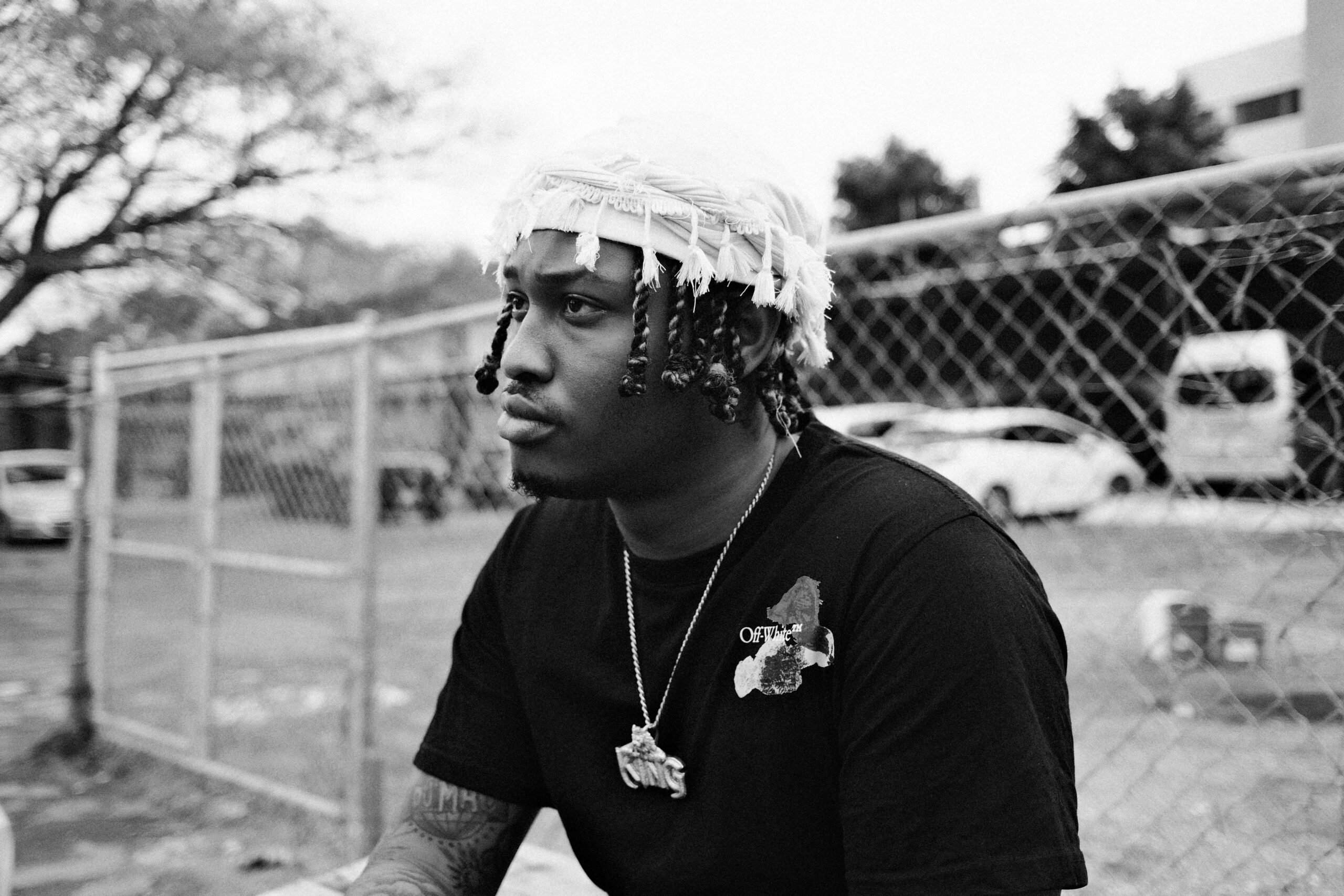

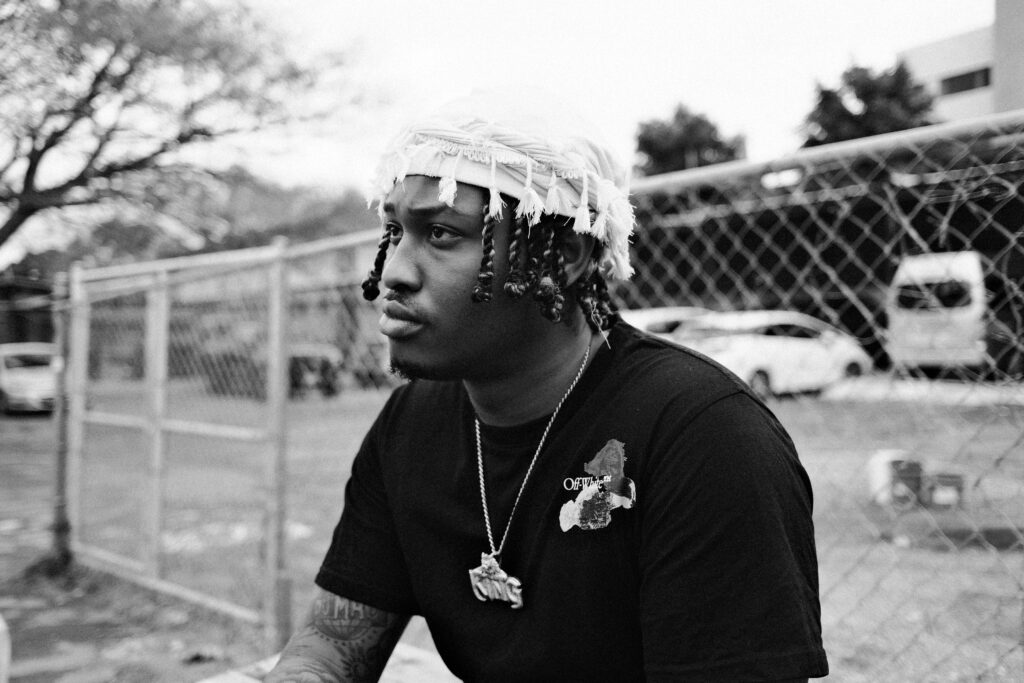
Kartel is king? Okay, then DJ MAC is the majordomo – or at least the leader of the New School, as his Insta bio says. For a good two years now, the 25-year-old DJ and producer from Kingston has been involved in what feels like every modern dancehall hit. 2023: The breakthrough with ”Drift” by Teejay. 2024: The soundtrack of the summer with the ”Fiesta” riddim. 2025: Firing on all cylinders with another monster juggling (”Down”), hits with Shenseea, Skillibeng, and various newcomers – and his first solo album, ”Ups & Downs.” Who is this guy who has apparently decided never to sleep again and instead just keep winning?
Text: Davide Bortot
This article was first published in September 2025 (RIDDIM 04/2025).
”Every time I like a new song from Jamaica, this name somehow pops up.” With these words, says DJ MAC, Shenseea booked a session with him through her manager Romeich. ”I have to go into the studio with him!” Was that really the case? Who knows. It doesn’t matter. What is certain is the result of this rumored anecdote: With ”V.I.P” and the remix of Ayetian’s ”Tip,” MAC and Shen Yeng have already landed two massive hits this year. Very Important Pussy? Definitely. Very Important Producer, too, though.
The two songs mentioned – released in April and June, respectively – are not only guaranteed to set the dance floor alight. They are also exemplary of the sound with which DJ MAC has developed from a local DJ sensation to one of the defining architects of the global Sound of Now within just a few years. The ”Tip” riddim (originally produced by Nathaneal ”Nvtzz” Brown and remixed by DJ MAC) is reminiscent of early Timbaland beats, in particular ”She’s a Bitch” by Missy Elliott. ”V.I.P,” on the other hand, begins like a flawless cover version of ”Independent Women, Pt. 1” by Destiny’s Child and consistently delivers Y2K R&B. Sonically, both tunes bridge the gap between the innocent playfulness of the late nineties and the hyper-compressed trap dancehall breeds of the modern era. Did someone say TikTok music? If I did, it’s meant in an entirely positive way.
The fact that dancehall in the summer of 2025 evokes memories of a time when most people on the dance floor couldn’t even eat solid food, let alone go to a party, is largely down to someone who has the same experience: Jason McDowell, aka DJ MAC. Born in 1999, he was socialized early on with Gaza Empire and other sinister dancehall designs of the time, but also with TRL on MTV and American pop music. Inspired by the mixtapes of hyped-up DJs of the time, such as Chromatic, Coppershot, and ZJ Chrome, which his big sister regularly brought home, young Jason began playing around with the VirtualDJ software. He made his first public appearance at the age of 13, at a school barbecue party in Kingston’s National Stadium. ”I was super nervous. But that’s where it all started. After that, I was kind of the official DJ at my school. That’s how everything developed step by step.”

DJ MAC still DJs at the National Stadium, for example at his annual joint birthday party with Jaii Frais from the ”Let’s Be Honest” podcast. It’s difficult to climb when you start at the top. Otherwise, ”evolve” is pretty accurate. DJ MAC started making music during the pandemic, more out of necessity than anything else. He learned the basics from Attomatic, Squash’s in-house producer, with whom MAC regularly cut dubplates at the time. His first release was a tune by the then largely unknown Skillibeng, ”Who.” Since then, he has recorded countless big tunes with the most important dancehall figures of the present day, including Valiant, Chronic Law, Skeng, Jahshii, Bayka, Kraff Gad, Govana, Teejay, and many more. (For the record: there is beef with the latter, but regular new music with all the others.) At the same time, he keeps breaking through with newcomers like Armanii, Tielo Lanez, and Jquan. ”Working with young artists has become my thing,” he says. ”It always has been. There’s just a more genuine connection. My biggest hits were all with people who were pretty unknown at the time. That hits different, I’m not gonna lie.”
The common thread in all of this is a party-friendly uptempo sound that has gradually transformed dancehall over the past 48 months and injected the genre with a whole new energy – even though he often draws his inspiration from the past. This was particularly evident in 2024 with ”Fiesta,” a juggling of massive tunes like ”HAAD” by Armanii and ”Trouble” by Stefflon Don. The riddim is a slightly revamped version of the 2001 ”Fiesta” riddim, which in turn is based on a US R&B song by some asshole who shall remain nameless at this point. So the origin: questionable. The selection: leaves no questions unanswered. ”That was the idea of my go-to collaborator CrashDummy. We just wanted to make music to dance to. That’s it.” Seeing the simple and making it look simple: that has always been a special art, especially in dancehall.

DJ MAC doesn’t just pull the strings and faders behind the scenes during such Eureka moments. He is also omnipresent as a public figure, as demanded by our times. On Instagram, he poses with celebrity friends and freshly ironed outfits. On TikTok, he gives insights into his work and previews of new music. And on DSPs, he cultivates his profile as an independent artist with currently over half a million monthly listeners on Spotify. That’s more than most of the deejays he works with. With his looks and his calm but determined manner, he comes across as a veritable star. ”Mac is so fucking fine ❤ very handsome,” one user commented under his latest interview on ”Let’s Be Honest.” This kind of conversation about a dancehall producer? Anything but a given.
Producers as pop stars don’t have a long tradition in dancehall. That’s surprising, considering that many Jamaican producers, especially from the early days of reggae, have become household names over time: Prince Buster, Scratch Perry, King Tubby. Today, their brands are almost bigger than their songs. Hip hop has also been providing role models for many years. Producers such as the aforementioned Timbaland, his childhood friend Pharrell, and Swizz Beatz have deliberately built up artist personas with recognizable character traits, almost comic-like features – and above all, their own releases. Today, Metro Boomin, Hit-Boy, and DJ Khaled are continuing this tradition, the latter without even getting his hands dirty with beat-making. He prefers to present himself as a cultural integration figure. In Germany, people know Jugglerz, Kitschkrieg, and Silly Walks. In Jamaican dancehall, on the other hand, producers have mostly remained in the background despite their prominent role in the musical revolutions of the past four decades. The best example is Dave Kelly, one of the most influential, if not the most influential, riddim smith of the 1990s. He stubbornly refuses to speak in public – and when it cannot be avoided, he only does so wearing a mask and voice distorter. At best, Di Genius has recently made a few tentative attempts to raise his profile, while Rvssian sought and found his salvation abroad.
Now DJ MAC is taking it a step further, as a kind of Jamaican Young Metro – almost as if he wants to counter the toxic dynamics and latent destructive self-perception of the Jamaican music industry with a new, self-confident approach. MAC has deliberately developed a signature sound with high recognition value and built up a small company structure for releases and other business ventures. He has a well-rehearsed team in the studio, an absurdly high output, and above all, a clear plan. In a Zoom interview (which is proactively offered to us on the occasion of his first solo album, ”Ups & Downs” – truly no longer the norm in times of All Social Everything), he speaks somewhat cautiously, but at the same time clearly and with control. He says he modeled his personal branding on DJ Khaled and Rvssian. The business side is important to him, especially that all producers and artists involved are paid fairly. He still works hands-on in the studio, but has less and less time, which is why most beats are started by producer friends such as CrashDummy or Raheem-WiddiBook, while he then comes in for feedback, additional ideas, or the right arrangement. He only DJs for fun now, but he still enjoys it. And of course, international collaborations are the natural next step, but he doesn’t want to change his foundation.
The present for DJ MAC is his first album, ”Ups & Downs.” Anyone expecting a collection of old and new party hits with accompanying celebrity appearances will be disappointed—or pleasantly surprised, depending on their preference. ”Ups & Downs” remains largely within the family and sounds much more tranquil overall than most of the MAC catalog. There are no hits like the ”Fiesta” riddim. Instead, there are songs like ”Vancleef,” a love song featuring Valiant, Kranium, and Nigy Boy, whose vibe is more reminiscent of the melancholic hip-hop reggae moments of Stephen and Damian Marley than the peak time at Uptown Mondays. MAC himself makes it clear that he wasn’t particularly interested in the expectations of fans or the preferences of the artists for this project. ”This project,” he says, ”is about me, about my journey.” For the first time as a producer, he had the opportunity to express himself through music, not just through the mix or arrangement of individual songs, but through the complete dramaturgy. It leads from melancholic and contemplative (”Ups & Downs”) to a surprising Admiral Bailey sample (”Siance”) to cautiously hit-worthy (”So Bad”), before ”Uptown” with Chronic Law and Valiant once again treats us to a full load of Y2K jiggy bounce, somewhere between Neo-Neptunes and Nelly in new. It ends with Lover’s Reggae and Christopher Martin. ”I wanted to express myself in this music. Sure, the uptempo stuff, the dance songs, that’s my brand. But I also want to establish myself as my brand, so that people can always expect something new from me.” That sounds far-sighted. The Now that DJ MAC is shaping could last for quite some time.
”Ups & Downs” is available digitally via Out Deh Records/DJ MAC MUSIC.