


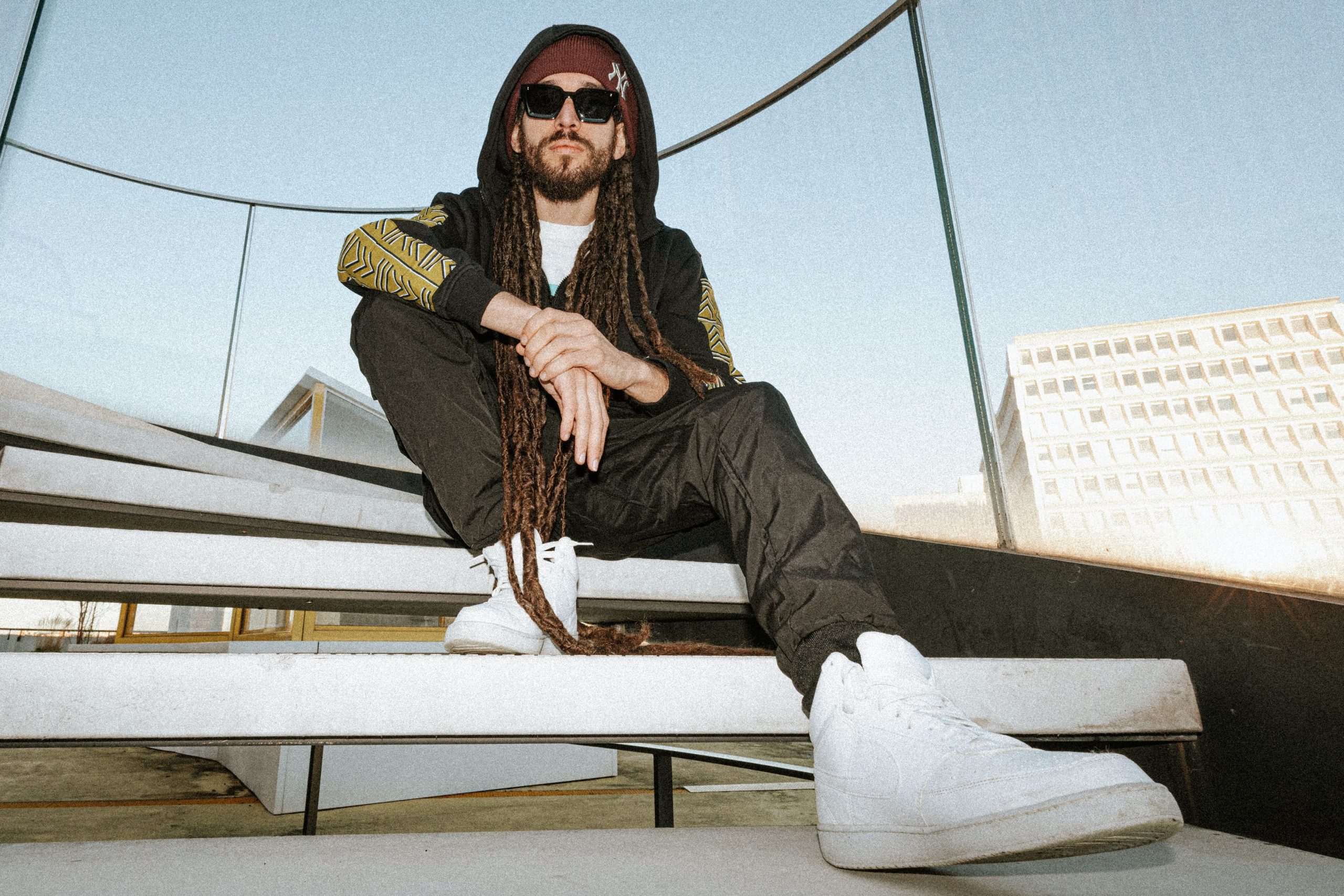
From sound system kid to sought-after dubplate broker and tireless producer at Evidence Music. The little lion from Geneva no longer has to knock on doors; today, artists come knocking on his, knowing that his reach extends far beyond their own bubbles. Simon Arnold traces the story of Little Lion Sound.
Text: Simon Arnold /// Photo: Laure Blanc
”Always be aware of your socio-digital bubbles created by algorithms.” A contemporary addendum to Kant’s dictum of Enlightenment. The bubble-ization of the world continues unabated. All the more striking, then, are phenomena that manage to break through the boundaries of digital perception bubbles. Take last year, for example: friends and acquaintances who normally wouldn’t even know where to put the ”a” in reggae suddenly start sending you YouTube links to a dubplate, leaving you wondering, ”what’s going on here?!”
Queen Omega’s going on. Her ”No Love” dubplate goes viral on ”social” media, lands on YouTube homepages around the world, and quickly racks up millions of views. The cleverly combined blend of Dr. Dre’s ”The Next Episode” instrumental and Queen Omega’s rapid-fire lyricism works flawlessly. No wonder the bubbles burst like jumping into a bubble bath.
Nicolas Meury of Little Lion Sound – the mind behind the hype – is fully aware of the spaces in which it takes place: ”The online audience is completely different from the traditional sound heads. And I’m really happy about that. Because it’s really touched people that don’t really know about reggae and they will just get some traction and say, okay well, that’s amazing, I’m gonna start to follow this project. And so they discover new artists and it brings reggae back to a much wider crowd. Then reggae as a whole moves forward.” The plan seems to be working. A look at the numbers confirms it: nearly four million followers on Instagram, more than 1.3 million subscribers on YouTube, and a sense of omnipresence across countless ”For You”-pages.
Behind these numbers lie years of work and dedication. Little Lion carries its name for a reason. When Nicolas Meury happens to hear a Bob Marley album from his older brother at the age of eight, he’s instantly hooked. He starts digging through what were still numerous reggae record shops in Geneva at the time (around 2000), soaking up everything his allowance will stretch to. When a first work placement is required after primary school, the destination for twelve-year-old Nicolas is clear: ”I used to go to Reggae Fever on a regular basis because it was next to the train station on my way to school. I asked about an internship, they said yes. After that I stayed and ended up working for them on a regular basis after school. I got paid in 45s. I learned a lot there about labels and artists.”

That same year, Nicolas begins DJing with the records he’s built up and founds his sound. When an unpopular slot opens up at the French online radio station ”Reggae Vibes,” he spots the opportunity and applies without disclosing his age. ”I got the Saturday evening slot, when all the other DJs were playing their dances, so they didn’t want that slot. Gradually I started getting invited to more and more dances – warm-ups, birthdays, school parties…” When every student at college is asked to realize an individual art project, Nicolas refuses to settle for something small and instead sets his mind on building a sound system. ”I said I just need some money to cover the costs, but I can take bring the project forward myself.” The result is a deal: the school covers the material costs, and in return Meury takes care of the sound at three end-of-year school parties. A no-brainer. ”Those school parties sparked a real movement of young people listening to reggae. There’s an entire generation in Geneva that when you talk about Little Lion Sound, they will know about it because they’ve seen us playing for these school parties.”
Reggae enthusiast, collector, DJ, sound system owner – and just finished school. So what next? Obviously: visiting Jamaica. But Mom and Dad Meury put the brakes on that idea for the time being – too dangerous. The compromise: a year abroad in New York. There, Nicolas connects with the Jamaican community and with Wayne Smith. The Little Lion starts earning money through dubplate sessions for European sounds. Back in Europe, tours follow with artists such as Al Campbell, Ranking Joe, and Wayne Smith.
From the very beginning, Little Lion is supported by the slightly older Mr. Nico and Inspekta Derrick, aka 808 Delavega of Derrick Sound, with whom he eventually founds the label Evidence Music in 2013. In what was initially a rudimentary but already Europe-wide recognized dubplate studio in Geneva, they now begin venturing into their own productions as well. Their first tentative steps come with the debut album of the electro-pop duo Lipka. Evidence gains national recognition with ”Ego,” the 2017 debut album by Swiss rapper Danitsa, for which they receive the Swiss Music Award in both 2018 and 2022. ”At first it was very eclectic in terms of style” Nicolas explains. ”We first had to learn the label business and find our place. Nowadays, we’re focusing almost exclusively on reggae. We realized that for reggae music, there was a lack of infrastructure to support the development of producers and artists. The knowledge we’ve acquired in the mainstream music business can now be applied to our work with reggae artists – trying to push the whole thing to a new level. So far, it’s quite effective.”
Fair to say. The label’s catalog has since become substantial, and the Geneva studio is no longer known only for lethal dubplates, but has also built a reputation for heavyweight productions. Asked which experiences linger the longest, Nicolas doesn’t hesitate: ”One time Sizzla came in with his entire entourage. We had the Trinidad embassy in the studio and the Jamaican one. When he stepped into the studio, there were lots of soundmen who were waiting for some dubs. But he said, ’No man, the first thing I want to do is just bless the place and just give you one track.’ And we recorded one song for the label, for Evidence Music. Those kind of vibes stick with you.” Verdict: Sizzla-approved.

Alongside studio work, the dubplate business remains a major part of what Little Lion Sound does. Years ago, Nicolas began recording the sessions not just with a microphone but also on camera, ”originally as proof for the other sounds to show that I had a direct connection with the artists. After I realizing the platform we were building with those videos, it was also good to highlight the work that we were doing with some local artists.” Those video dubplates evolved from exclusive artworks into promotional tools – both for in-house productions and for young, up-and-coming artists. Today, Nicolas no longer needs to approach artists and ask for collaborations; the offers pile up, and close partnerships with artists such as Brother Culture, Ranking Joe, Queen Omega, Eesah, or Micah Shemaiah are firmly established. The studio in Geneva has established itself as a regular stop on many artists’ European tours, and a dubplate for Little Lion is always on the cards.
Some sound boys took offense to what they perceived as the repurposing of their favorite art form into an inclusive entry point to the scene: ”When we started recording and publishing the dubplate videos, some were fighting against us. People said dubplates had to be exclusive, that you should only hear them in a dance. But at the end of the day, for me, when you’re making music, you want to touch as many people as you can. Society has evolved – just like the tools we have at our disposal to push the music and the message. If we can find vectors and ways to reach a wider crowd, then let’s use them.”