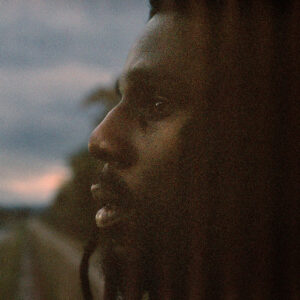


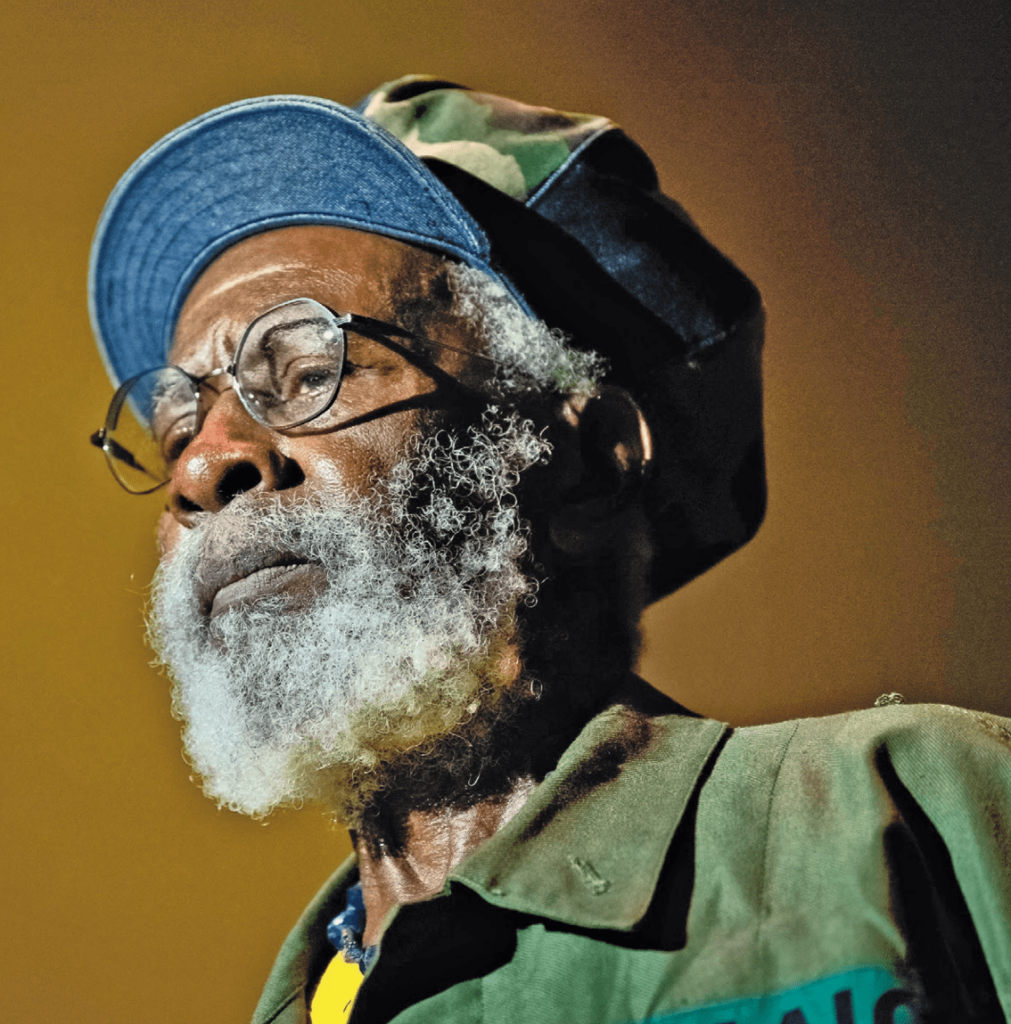
Last year, his concerts were still thought to be a once-in-a-lifetime opportunity. It is now clear that one of the last living reggae icons has come back to stay – at least as long as his health allows. And judging by his performances, he is in top form and in the best of spirits. Both of these qualities also characterise his first album in over 15 years. David Katz spoke to the usually taciturn and moody Burning Spear about ”No Destroyer,” some of the highlights of his career and his plans for the future.
Text: David Katz /// Photos: Lee Abel
This article was first published in September 2023 (RIDDIM 04/2023).
On the other end of a trans-Atlantic phone line, Burning Spear begins a sung benediction, praising Rastafari in quavering vibrato. ”As far as I can see, everything is alright with me,” he offers, shifting up an octave to defend Marcus Garvey, the Jamaican hero of black self-determination he has continually venerated. ”Marcus Garvey has been accused many times wrongfully, we need his name to clean up and set his record free…free…free…!”
With laughter in his voice and an unusually relaxed playfulness, Spear is obviously in bright spirits. For many years he has largely absented himself from the reggae sphere, emerging from his somewhat remote New York homebase for only a handful of live shows, typically staged in the USA; there were also times when he engaged in bouts of seemingly self-destructive online trolling, blasting virtually everyone he’s ever worked with via random posts that verged on the extreme. Then, last summer European audiences were unexpectedly treated to several high-profile performances, the first in many moons, which saw our hero in fine form, despite advancing age. And as Spear prepares to return the favour this summer at select festivals and venues, fans will finally be able to embrace the long-awaited arrival of ”No Destroyer,” the first new Burning Spear studio album in over 15 years. ”We’re not rushing anything cause I don’t think it’s wise,” says Spear of the new LP. ”The time got to be right for me, and then again, the time will always be right for the people, for they are the ones who support me, and they’re always looking forward to seeing something coming from Burning Spear.”
”No Destroyer” is another great instalment in Burning Spear’s incredible catalogue, which encompasses at least 22 original studio albums, not counting the many volumes of the ”Living Dub” companion series, and compilations. And I’m pleased to say that the end result is worth the wait. Mixing deeply personal statements with songs that implore humanity to do better, praising reggae’s everlasting qualities alongside appraisals of his own career, ”No Destroyer” bears the hallmarks of high production values and proper musicianship that have always been present from the start, with a well-rounded horn section, bluesy guitar accompaniment and understated female harmony vocals giving subtle embellishments to Spear’s forceful lead. It’s a sound that is thoroughly contemporary, building on the classics of the past without aiming for something ”retro.”
Opening number ”The Spear” sets the tone with a brief survey of what Spear is all about: concerned with promoting peace and love instead of an ego trip, he’s the reggae figurehead that takes his time, imparting his message in good faith and without competition. On the title track, Spear reminds that he’s seeking no fame at this point, being more concerned with symbolically refuting any negative destroyer that might seek to nullify his natural blooms; ”Independent” highlights that Burning Spear has always followed the beat of his own drum and despite attempts to sabotage, he continues to move forward; industry sharks are also berated on ”Talk,” ”No Fool” and ”They Think,” but the album celebrates reggae music’s positive sides too. Indeed, on the upbeat ”Open The Gate,” Spear personally thanks Chris Blackwell of Island Records and Clement Dodd of Studio One for bringing reggae music to the world, along with Robert Nesta Marley, Alton Ellis, Culture, Dennis Brown and other pioneering figures. ”Jamaica” points to the enduring qualities of roots reggae and ”Obsession” salutes various branches of the Rastafari faith while reminding of the need for taking personal responsibility for one’s beliefs, all delivered in poetic language atop a rhythm that would not be out of place on a Steel Pulse album, which morphs into a lengthy dub workout. Moving to the more general, Spear implores scientists to make medical breakthroughs on the optimistic ”Cure For Cancer,” sings the praises of Jamaica’s northwest party town on ”Negril” and on the heartfelt single ”Mommy,” he details a family’s struggle to persevere in the face of the grave hardships of our contemporary present, named by Spear as among the album’s most pertinent works.
”It’s a strong song dealing with the families, basing upon the Coronavirus, but this song been recorded way before,” Spear emphasises. ”What I’m saying is that things is not gonna be the same as before; here comes the Corona and hundreds and thousands of people never get that call back to their jobs and they are never gonna get that call. So it’s more like a story for parents to sit their kids down and tell them about what happened after the Corona: here comes daddy, he’s on the move looking something to do, and mommy’s at home just hoping that daddy will come through with some food so they will able to prolong with their lives and take care of their family. That’s what the song’s dealing with.”

At the age of 78, Burning Spear is among the last surviving reggae icons, and it marvels that his wide-ranging tenor remains undiminished. Having kick-started the roots reggae subgenre at Studio One in 1969, he achieved international acclaim in the mid-1970s through a series of hard-hitting albums that rank amongst reggae’s all-time greatest, his stalwart position maintained through quality releases and sporadic tours characterised by marathon performances with superb musical backing, but keeping up the momentum has inevitably become more difficult with the passing of time. ”It’s not something I always want to do, but it’s all about the people,” says Spear, with a slight stammer. ”The people are always requesting me, and I know that the people come first.”
Born Winston Rodney in 1945 in St Ann’s Bay, a sizeable fishing port on Jamaica’s north coast that is the capital of St Ann’s parish, Burning Spear sees himself as part of a trinity of local heroes, together with Marcus Garvey and Bob Marley. ”I‑man were born at 12 King Street, off Market Street, which was where Marcus Garvey were born, and Bob also was from the same parish, so it’s the three of us as one,” he emphasises. ”Growing up, I had four brothers and eight sisters, so it’s a huge family, and I most likely be the second youngest. My home life is just like any other home life, where you have to obey your parents; my mom was a cook and my father do road construction and my parents was Pentecostal, so I had to go to church two times for the day — you ain’t chickening out on that!” Young Winston focussed on sports at school, until music infiltrated his consciousness. ”At St Ann’s Primary, I was pretty happy as a young person because soccer and swimming and running was my main hobbies. So growing up, I wasn’t thinking about music or trying to sing. It happened by listening to other artists who were working many years before me.”
”I was listening to the real hardcore, I wasn’t listening to the fancy side of reggae music. And one of my main people who I was listening to is Bob; I would listen to every one of Bob’s songs.”
Curtis Mayfield and James Brown were among the foreign singers who inspired him, but local stars made greater impact as the fledgeling Jamaican music industry solidified. ”I started to feel this music from the late-’50s into the early ’60s, and this music’s coming from a distance, cause it was mento, ska, rock steady, all those changes the music came through, and it’s the same music that turn itself into reggae. Jamaica had so much musicians, like there was the great trombone player, Don Drummond, the guitarist Ernest Ranglin, and there was some great people out there who were singing, like the Heptones, Larry Marshall, Peter Tosh, Alton Ellis. All those brethren were there before I‑man, so I was listening to the real hardcore, I wasn’t listening to the fancy side of reggae music. And one of my main people who I was listening to is Bob; I would listen to every one of Bob’s songs.”
When Winston Rodney came of age, he worked various menial jobs to make ends meet while broadening his mind through discussions with elders, who told him of Garvey’s visionary qualities and the pioneering campaigns for black betterment. Ultimately, the spiritual awakening that pointed him in a different direction came through mystical wonders, experienced at a local beach. ”I used to do dry cleaning, car washing and tiling, but here comes as Jah wish, for me to be a musician or an artist, and that is it,” he says, definitively. ”I was on Key Largo Beach, near where Marcus Garvey used to be located at 1 Jail Lane, and that’s where everything start to happen: I‑man start to see my roots, my culture, my history, where I’m coming from originally, my people before me and my great-grandfather’s‑father’s‑father, so that’s where I say ‘Rastafari’ for the first time, that’s where I grow my dreads. The awareness come to I‑man based upon my energy, for you’ve got to be open thinking, and the energy just came right there on the beach, and I don’t even know where the lyrics came from, but the lyrics did come. And after a while, here comes melodies, so I sing it and I do the best I could with it. Lyrics or melodies is not something you really look for, and when it comes you’ve got to accept it and store it. So at Key Largo Beach, where Marcus Garvey used to be located, that’s where everything get started.”
”The energy just came right there on the beach, and I don’t even know where the lyrics came from, but the lyrics did come. And after a while, here comes melodies, so I sing it and I do the best I could with it. Lyrics or melodies is not something you really look for, and when it comes you’ve got to accept it and store it.”
During this transitional phase, Rodney sometimes hitchhiked to the capital, where he would reason with Rastafari brethren in the sprawling slum of Back-O-Wall in western Kingston, which led to his distinctive stage name. ”At times I was in Kingston, just hanging out, then I would go back on the north coast, so I start to intertwine with people. I used to go to Industrial Terrace off Spanish Town Road, that was the joint where you could get your little smoke and drink a beer, talk a little with a guy named GG, a man who love to play him guitar, and there were this man, we call him Nyah, and one time Nyah asked if I knew about Jomo Kenyatta. He read up a lot on African history, and he told me, ‘Man, it’s a good name to carry as an artist,’ then I decided to go with the name, now that I get the full understanding of who is Burning Spear, the first republican president of Kenya.”
As noted on the millennial single ”As It Is” from the ”Calling Rastafari” album, Burning Spear was directed to Studio One by Bob Marley, the chance meeting taking place when he and his peers were deep in the St Ann’s countryside, close to Marley’s birthplace of Nine Mile, seeking quality herb and foodstuffs to barter back in town. ”That area is where most of the herb was cultivated at that time, so we went into that area to get some good smoke,” says Spear. ”At the same time we want to bring coconut oil and other stuff that they just don’t have in town, so we bring things to create an exchange, and I saw Bob coming down the street with his donkey and a lot of plants; Bob was going to his farm, doing his own cultivation, and at that time, Rastaman and Rastaman stand firm and was reasoning. I remember asking him how I could get started in this music business and Bob asked I if I know of Studio One.”
Winston Rodney thus made his way to the fabled recording studio on Brentford Road founded by the former cabinetmaker and sound system proprietor Clement Dodd in the early 1960s, travelling there with Rupert Willington, who sometimes carried harmony when Rodney sang informally in St Ann’s Bay. The Jamaican charts were then filled with frantic, organ-led dance tunes and innocuous love ballads, but the song they auditioned with was startlingly different; ominous, forceful, and weighty, its biblical lyrics delivered in thick patois with uncommon vocal phrasing, it warned of dubious informers and exhorted the Rastafari faithful to join together in peace, chanting down the oppressive forces of Babylon.
”I saw Bob coming down the street with his donkey and a lot of plants. And at that time, Rastaman and Rastaman stand firm and was reasoning. I remember asking him how I could get started in this music business and Bob asked I if I know of Studio One.”
”When I reach in town, it was exciting, but I wasn’t even paying the excitement too much attention; I just want to go there and express myself musically and let out what’s inside of I‑man, that I’ve been carrying for all these times,” he explains. ”So I came to Studio One and tell Mr Dodd, ‘Bob say I should come to you,’ and Mr Dodd say I should sing what I got, and the first song that came out is ‘Door Peeper.’ And Mr Dodd was happy. He never heard anything like that before, so to him, perhaps this can be gold! Rupert Willington did background vocals on a few songs and then he walked away. But I didn’t walk away, I stood up.”
Rodney remained at Studio One to produce the albums ”Rocking Time” and ”Presenting Burning Spear,” yielding a second hit in 1973 with the devotional ”He Prayed” (AKA ”Joe Frazier”), framed by a striking trombone line. ”In the song, I speak about Jah prayed for I and you, until his sweat turned blood,” Spear explains. ”I don’t deal with colourism, nationality, or religion; I say glory be to Jah, the creator. We give thanks to the universe, to nature.” However, like many of his peers, Burning Spear became frustrated by the financial arrangements at Studio One, but concedes that he gained invaluable experience at the facility known as Jamaica’s Motown. ”When the Heptones and Delroy Wilson were recording, I see what’s going on, and after that I started to think for myself and arrange all my songs them. But Studio One wasn’t bringing me anything when it comes fi like a salary; Mr Dodd keep it all for himself. So going to Studio One is like, when you’re a kid, you go to school until you graduate, and when you graduate you move on. So I walked away but I didn’t walk away from the music; I walked away from Studio One still maintaining my creativity musically.”

The timing of his break with Clement Dodd proved fortuitous, since sound system proprietor Jack Ruby, who hailed from Greenwich Farm in western Kingston but who was then already based a few miles east of St Ann’s Bay in Ocho Rios, was contemplating a move into record production himself. Having long championed Burning Spear’s work on his sound system, Ruby convinced Rodney to record for him with two backing vocalists, resulting in the temporary return of Rupert Willington, along with another St Ann’s Bay hopeful, Delroy Hines. ”There was an audition taking place at the Federal Theatre in my town, so I went there and sing about Marcus Garvey and about slavery days, but I was turned down,” Spear continues. ”Then here comes Jack Ruby on the beach, saying he heard that I have two good songs, ‘Marcus Garvey’ and ‘Slavery Days’, and he wouldn’t mind working with me. So from argument to argument we decided to work together.” The resultant ”Marcus Garvey” is a landmark album that contained celebratory odes to the Jamaican hero, as well as unflinching portrayals of slavery and Jamaica’s post-colonial aftermath, as heard on ”Slavery Days,” ”The Invasion,” ”Give Me,” and ”Tradition.” Burning Spear thus became one of Jamaica’s most popular performing artists, the album’s overseas issue by Island Records greatly expanding his audience. Jack Ruby produced the follow-up set ”Man In The Hills” before parting company with Burning Spear, and although all of Spear’s subsequent work was self-produced, he maintained respect for the inventive producer. ”Jack was a good producer because Jack was a music lover. If Jack sees something in any young person out there, Jack would try to help them, musically. Jack did some good work, and there was no problem amongst us; we do two albums together and after those two albums, that was when I start my independence.”
”It meant a lot to me as an old guy, where something went wrong in another country and it reach up to where you live, and they come up with protection that you can protect yourself from getting that virus, so I became a part of the plan. I don’t care about criticism, and what about the man who took the vaccine and hide? I live in health, and I don’t live in criticism, so I didn’t pay that no mind.”
Along with Rastafari-oriented scorchers like ”Lion” and a jazzy scat vocal titled ”No More War,” aimed at Jamaica’s politically aligned street gangs, ”Man In The Hills” allowed Burning Spear to record new versions of songs he had not been properly recompensed for at Studio One. Working this time in the better-equipped confines of Harry J’s studio, the fiery horn section, expertly arranged by veteran trumpeter Bobby Ellis, was captured in all its sonic glory, as Leroy ”Horsemouth” Wallace’s furious drumrolls and accented rimshots locked tightly with Robbie Shakespeare’s rumbling bass. The mixture of old and new was also present on 1977’s ”Dry And Heavy,” by which time Willington and Hines had departed, and when Island paired Burning Spear with Aswad for his first British tour, the musical chemistry was potent, as heard on the acclaimed concert album, ”Live At The Rainbow.” ”When I hit the Rainbow Theatre and other places in England, everything come out successful,” says Burning Spear. ”It was strong when I first see my fans in England, and it was good for Aswad too.”
Aswad would make a guest appearance on ”Social Living,” the last album Burning Spear cut before leaving Island for EMI, which released ”Hail HIM,” ”Farover” and ”Fittest Of The Fittest” in the early 1980s. Burning Spear would continue to record the bulk of his work in Jamaica, but by the time he began fielding it to American independents such as Slash and Heartbeat, he had shifted his base to Queens in the greater New York metropolitan area. ”Because of my works, I think this is the right country to come to, because in this country, musically, things can happen,” he says pragmatically. ”What are you gonna do back in Jamaica? How much records you gonna sell? Who gonna be there to give you that kind of promotion to the record buyers? How much people is it going to be reaching to? When you’re in business, you have to think where you can go to make your business continue to be successful.”
In the new millennium, Burning Spear would be granted the Order of Distinction for his services to the Jamaican music industry; he performed in South Africa and Kenya, momentous occasions that helped him to reconnect with his African heritage, and he also helped build an infant school and infirmary in St Ann’s Bay. Then, during the early days of the pandemic, as conspiracy theories and fake news ran riot, several high-profile reggae artists made anti-vaxxer statements, with Sizzla even recording a song titled ”No Vaccine.” But Burning Spear showed wisdom, courage, and foresight when he spoke publicly about his double-vaccination status during a lengthy interview, broadcast on radio station WPKR in April 2021.
”It meant a lot to me as an old guy, where something went wrong in another country and it reach up to where you live, and they come up with protection that you can protect yourself from getting that virus, so I became a part of the plan,” he explains. ”I don’t care about criticism, and what about the man who took the vaccine and hide? I live in health, and I don’t live in criticism, so I didn’t pay that no mind.”
Before our interview drew to a close, Burning Spear was keen to point out that, in addition to ”No Destroyer,” there is a new instalment of his ”Living Dub”series to come, as well as new songs about Marcus Garvey and other important topics; he sees this work as part of his calling, and will continue to produce it and perform it as long as possible. ”Everything I’ve done, I’m proud of it,” he says with a smile. ”My work is a gift given to I‑man by the Most High, and I accept that and just exercise it.”
”No Destroyer” has been released in all formats by Burning Music.