

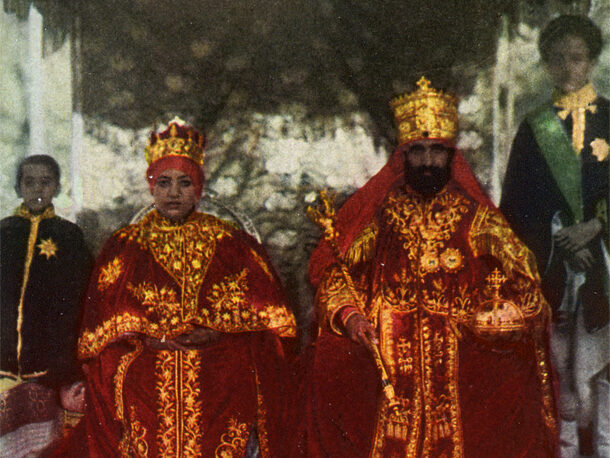
The 90th anniversary of Haile Selassie I’s accession to the throne on 2 November was of course also celebrated with Nyahbinghis in the Covid year. Even if, for the first time in the history of Rastafari in many parts of the world, these only took place virtually. Reason enough to reflect on the significance of Haile Selassie in today’s global society. The focus is on his lifelong struggle against racism — as a precondition for Black African Liberation, international morality and universal freedom (from oppression). Part I looks at the Rasta perspective of the Conquering Lion of the Tribe of Judah. In the next issue, Part II will deal with Haile Selassie from an Ethiopian and global perspective.
Text: Werner Zips /// Photos: ababajahnoy.com
This article was first published in December 2020 (RIDDIM 01/2021).
Haile Selassie As The Centre Of Rastafari (And Reggae)
It is probably no coincidence that Haile Selassie I has never been the subject of a report in almost 20 years of RIDDIM. Although it could be argued that the King of Kings – Negusa Negast – should have been on the cover of the first issue in the first year of the third millennium instead of Sizzla. After all, Haile Selassie is at the centre of Rastafarian philosophy and culture. As this in turn represents the nucleus of reggae, Haile Selassie can also be understood as the heart of this musical genre. The worship songs of Sizzla and many other artists provide countless examples of this. This is by no means only true for roots reggae. No name is mentioned more often in dancehall than that of Haile Selassie.
Nevertheless, even the attempt to describe who Haile Selassie ”really” was would be highly presumptuous and ultimately doomed to failure. Even an approximation of the ”true” meaning of Haile Selassie for Rastafari must fail due to the diversity of individual experiences, inspirations and cognitive processes. Indeed, even a statement such as ”Haile Selassie is the heart of Rastafari,” which is initially true for many Rastas, would be contradicted at second, longer glance. For example, that Haile Selassie is by far not only the heart, but the origin/creator, the head, the world view, the Livity (or way of life), the inspiration of all ways of thinking and acting, the motor of all development, even more, the source of all spiritual enlightenment and the basis of one’s ”own” identity.
This is probably the real reason why the RIDDIM editorial team has so far refrained from writing its own story about the Ethiopian emperor. Haile Selassie has been the subject of countless articles, but usually only by way of an artistic interpretation, especially by reggae artists. There is one main reason why I am nevertheless writing about Haile Selassie here and risking burning my fingers (in a time of anti-racist ”race” and skin color discourse): the topicality of Haile Selassie’s key message of Black (Pan-) African Liberation and the simultaneous equality of all people regardless of ”race,” skin color and ”class.”
African Universality
Rastafari, as a global philosophy emanating from Jamaica, is both a witness to this attitude and its most important ambassador via the mass medium of reggae. But One Love & Unity is having a hard time right now, as the focus on reggae and racism in the last issue made all too clear. The structural violence that the murder of George Floyd drastically demonstrated can be recognized in myriad legal, political and everyday practices. The deliberate deaths of refugees in the Mediterranean, the immigration laws for integration, migration and asylum as well as interpersonal ”othering” are just a few facts on an endlessly long list.
They drive wedges into social coexistence that do not even stop at the few islands of functioning togetherness – and I count reggae as a form of coming together, despite all its complexities, as one of these rare horizons of hope. It seems as if at least large parts of the world are increasingly divided by identity conflicts instead of recognizing the division into ”races” as the cause of countless catastrophes, triggers for immense psychological stress and countless crimes and massacres (as Achille Mbembe writes in his ”Critique of Black Reason”).
This raises the question of whether the idea of equality and freedom, which Haile Selassie brought into the world, is no longer in keeping with the times. And consequently whether the bracket around Blackness and Oneness, which Rastafari and reggae are based on, should be abandoned as an illusion. No one can answer this question conclusively. Nevertheless, it is worth thinking about it. To do so, it is first necessary to visualize the dimension of the Black African Liberation postulated by Haile Selassie as a precondition for the equality of all people. In contrast to the European Enlightenment, this is a practice-orientated and not just a theoretical universal concept. It contains a notion of universality originating in Africa that carries the promise to fulfil any principle of equality (as enshrined in Article 1 of the Universal Declaration of Human Rights).
”Until the philosophy which holds one race superior and another inferior is finally and permanently discredited and abandoned.”
The Double Rasta Imperative
Rastafari and reggae have defined this double imperative – of Black African Liberation and Equal Rights & Justice – in a creative way. It encompasses the liberation of all Africans – ”at home and abroad” – but also the liberation from all manifestations of racism. This is based on the construction of ”races” and their arbitrary evaluation. ”One Love,” the message spread worldwide by Rasta and reggae – above all Bob Marley – is therefore not a feel-good phrase or even a social utopia based on self-interest (such as increasing record sales). Rather, it has a radical and revolutionary dimension. Radical in that it reaches down to the roots of the global imbalance: the untenable division of the one human race into ”races” on the basis of skin color and other external characteristics. And revolutionary, in that the liberation struggle for equal rights and justice precedes the desire for peace.
Peter Tosh put it in a nutshell in the title track of his first solo album ”Equal Rights”: ”I don’t want no peace, I need equal rights and justice.” Starting ”from the little island, Jamaica” with its ”big, big music,” Haile Selassie’s universal claims to justice went around the world after they were initially taken up by the first Rastafarians such as Leonard Howell and translated into a decolonial philosophy. In this respect, global hits such as ”One Love” are based on a practice that has been lived for decades, as expressed in the old Rasta greeting ”Peace and Love.” While at the same time emphasizing the basis of sustainable peace – ”Justice for All.” I would like to explain from my own experience of Rastafari that there is more to this than a mere myth.
”Until there are no longer first-class and second-class citizens of any nation.”
There Is A Picture On the Wall…
My first ”personal” encounter with Haile Selassie had to do with the aforementioned Peter Tosh album. It took place in Vienna in 1977: in the form of the Jamaican rasta Emsley ”Jah T.” Smith, the owner of the first reggae record shop in Vienna. He greeted me with ”Rastafari!”, accompanied by a dignified bow as he placed his right hand on his heart. Behind him hung a portrait of Haile Selassie with a red, gold and green banderole. It is no exaggeration to say that this moment changed my life.
I was already familiar with Rasta and reggae before that. ”Exodus” and ”Rastaman Vibration” were played up and down in my circle of friends. But despite the infectious riddims, I found the biblical references unconvincing, especially as I associated the Bible more with the Pope in Rome, the subjugation and destruction of Mother Earth and the enslavement and colonization of Africa. Emsley ”Jah T.” Smith was to prove me wrong. Just like practically the entire early reggae community in Vienna, for whom he was something of a godfather. Until he realized his lifelong dream at the end of the 1980s and moved to Dar es Salaam in Tanzania — as his personal repatriation. There, of course, he continued his mission, first with his Sound System, then as radio DJ ”Baba T.” for East Africa Radio. Now, with more than 80 years as a roots rock reggae MC, he is slowly applying for the Guinness Book of Records.
Who is Jah?
Like many of his peers and biggest reggae stars such as Bob Marley and Dennis Brown, Emsley belonged to the Twelve Tribes of Israel, the biggest Rasta house of the last millennium. Its founder Prophet Gad, Dr Vernon Carrington, interpreted the Bible, especially the Old Testament, as a theology of liberation with Haile Selassie as the returned redeemer. Anyone who was able to attend one of the monthly meetings at the Twelve Tribes Headquarters, diagonally opposite today’s Bob Marley Museum, knows the vision of Haile Selassie from the greeting formula that each of the twelve High Priests repeated before his address: ”Greetings in the Most Precious & Divine Name of our Lord & Savior Jesus Christ who has in this day revealed Himself to us in the Wonderful Personality of H.I.M. Haile Selassie I., King of Kings, Lords of Lords, Conquering Lion of the Tribe of Judah.”
Most reggae fans should be familiar with this formula of ”Christ in his Kingly Character.” Garnett Silk and countless other Twelve Tribes artists still use it today in one variation or another as a take-off for their performances or praise songs. The long version of these standardized greetings, which is easy to find on the web, is a commitment to the Ethiopian Orthodox faith and the restoration of the Ethiopian monarchy. Rastafari as a ”faith” is therefore not based on scriptures, rites, vows or laws, but on an inwardly directed function of the heart, which is achieved through mystical internalization or unity as a whole. This is something that the Twelve Tribes have in common with other Rasta houses. But in the Twelve Tribes, this form of spiritual experience leads to the ultimate conclusion of a ”rebirth in Rasta”: ”In plain words, to be Born Again.” Other Rasta houses such as the Nyahbinghi Theocracy and many Rasta freethinkers such as Mutabaruka no longer go along with this, however, because the ”born-again” concept reminds them too much of the Judeo-Christian tradition, especially the Jehovah’s Witnesses. But more on that later.
Jah T. was very aware of his broad impact as probably the first Rastafarian from Jamaica in Vienna at the time. His Rastaman Vibration shop quickly became a kind of Rasta community centre. According to the principle ”many are called, few are chosen,” Jah T. was only available to those who were credibly interested, but then ”in fullness”, so to speak with skin and dreadlocks. He represented Haile Selassie I and the Rastafarian philosophy and culture that continued to develop around this core, not only from the perspective of the Twelve Tribes, but in all its diversity. When I first travelled to Jamaica in 1984, I therefore had a prior understanding of other Rasta visions such as Nyahbinghi and Bobo Ashanti. As an ethnologist, I was familiar with the literature available at the time. Without first-hand Rasta experience, I would have been somewhat lost, despite or because of this.
Lifesaving Teachings
For me as a young student at the time, the exchange with Jah T. was a kind of intensive course in anti-colonialism, pan-Africanism, global justice, Rastafari and Haile Selassie. This would soon prove to be a lifesaver. Just five days after arriving in Jamaica, I ended up at a Nyahbinghi. Unknown white people were and are screened thoroughly on such occasions. Anyone who doesn’t pass is ”burnt”, i.e. thrown out. The most important question you are confronted with first is: ”Who is Jah?”
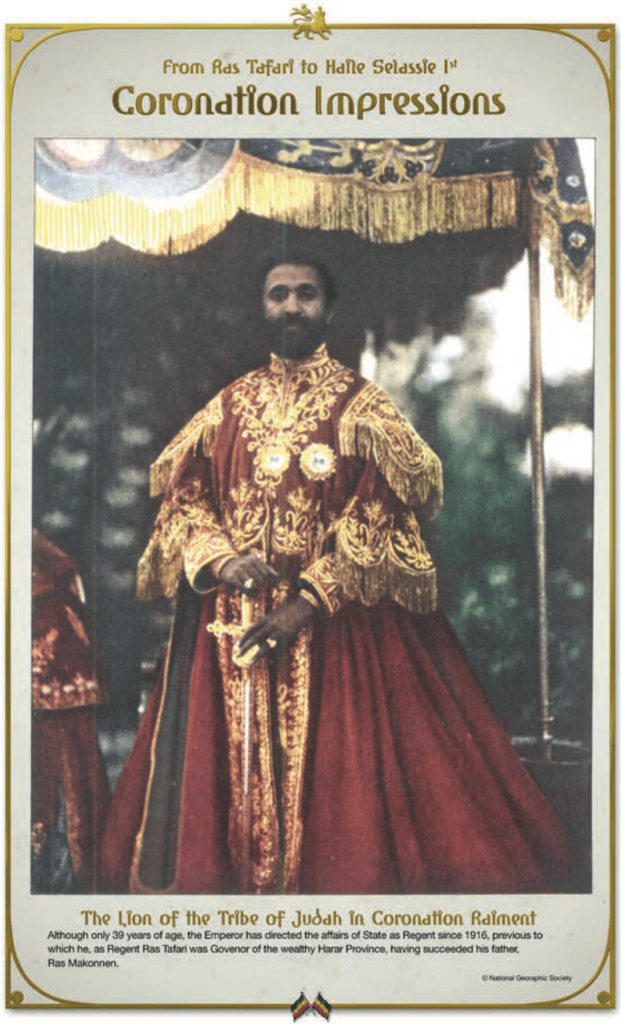
Reasoning with Emsley prevented me from answering with book knowledge. For example with the following description: The 225th king of kings on the throne of David, Ras Tafari Makonnen, crowned as Haile Selassie I, which in Amharic means the ”power of the Trinity.” The descendant of the legendary King Solomon of Jerusalem and Queen Saba of Ethiopia, whose father Ras Makonnen Wolde-Mikael Gudissa travelled to Rome in 1889 to witness the ratification of the treaty of friendship with Italy after the victorious battle of Menelik II at Adua. The returned Savior who, according to biblical revelation, proved himself worthy to open the book with the seven seals. The Chosen One of God – in the Rasta phrase Elect of H.I.Mself. Ababa Janhoy – the Great Father. In short: The Conquering Lion of the Tribe of Judah, Jah Ras Tafari!
Apart from the fact that, surrounded by dozens of Nyahbinghi Warriors on the battlefield of a Nyahbinghi – all shouting ”Death to Black and White Downpressors!” – I would have failed miserably, even a reasonably successful recitation of Haile Selassie’s titles and epithets would have sounded like nothing more than empty, rehearsed words. My answer to ”Who is Jah?”, on the other hand, was as meaningless as it was sincere: ”I am going to experience it.”
She summed up what I had learnt from Emsley and not from books: ”Rastafari is no doctrine, Rasta is an experience!” A young Soldier in Jah Army was anything but satisfied with my answer. Full of the ”righteous wrath of God,” he shouted the question even louder in my face: ”Who is Jah?” To which one of the Elders present, dressed in a biblical outfit with a priestly staff, a floor-length red, gold and green robe and a dreadlocks mat down to the back of his knees, replied calmly but firmly in my place: ”He told you already, he is going to experience Jah!”
”Until the color of a man’s skin is of no more significance than the color of his eyes.”
Why is this important? Most people and scholars who deal with Rastafari usually look and ask about appearances, be it in the form of physical appearances (dreadlocks, ganja, style & pattern), be it about the ”objective” historical figure of Haile Selassie or the valid justification for repatriation to Ethiopia (or Tanzania or Ghana or wherever). This misses the approach of Rastafari as an exclusively ”inner” experience that is shared in communication with others – the Reasonings – and thus unfolds into a global universe of discourse.
Jah T. was the first to teach me with the patience of an angel to understand Rastafari as ”unity in diversity.” For a social scientist like me, this is anything but self-evident. After all, social science aims to make universally valid statements. Answers such as ”it depends” are considered unsatisfactory. Nevertheless, this answer to the question ”Who is Jah?” or Haile Selassie, for that matter, is the only correct one – at least from the perspective of different Rasta experiences; the plural is important here.
”Until the basic human rights are equally guaranteed to all without regard to race.”
Haile Selassie As A Multifaceted Experience
Mutabaruka, the Rasta freethinker and poet of liberation who (after Jah T.) has had the strongest influence on my thinking not only, but especially about Rastafari, puts it in a nutshell in the book ”Rastafari — a universal philosophy in the 3rd millennium”:
”There is not ’the one’ Rasta religion. Even if one would like to see Rasta as a religion. But there is a Rastafari experience. The experience is the way you live your life. And the person in New York City who experiences Rastafari will not say the same thing as the person who lives in Kingston, or the person who lives in Westmoreland (Jamaica) in the mountains. These are completely different experiences. But one thing is of overriding importance: at the centre of these experiences is Haile Selassie. As a result, you will hear a Rastafarian in New York say Haile Selassie and the person in the mountains say Haile Selassie and the person in Kingston say Haile Selassie. But how he came to Haile Selassie is completely different, completely different. And that’s what confuses the sociologists who want to study Rasta, because they are looking for a pattern that they can analyze.”
Anyone looking for contradictions within Rastafari will quickly find them. Attending a meeting of the Twelve Tribes conveys Haile Selassie as the reincarnation of Jesus Christ. A visit to Bobo Hill in Bull Bay with the Bobo Shanti places Haile Selassie as Black Christ in Flesh within a concept of the Trinity with Marcus Garvey as Prophet and King Emmanuel as High Priest, focussing on the spiritual, priestly experience of King Emmanuel’s teachings. Through this experience, the royal teachings and deeds of Haile Selassie and the prophecies of Marcus Garvey are filtered to a certain extent.
Participation in a Nyahbinghi of the order of the same name realizes above all the worldly experience of the struggle against injustice in the form of colonialism, exploitation, slavery and political oppression. Haile Selassie is above all a cipher for Black Power and Black African Liberation, combined with the experience of the divine self — expressed in melodious and endless ”I‑I-I-I-I-I‑I” chants. To the heartbeat of the bass drums, Haile Selassie is experienced physically (embodiment). He takes shape in the participants. The statement of Bob Marley’s ”Jah Live” as a reaction to the news of Haile Selassie’s death on 27th of August 1975 can also be explained by this: Regardless of his physical existence, Jah lives on in every single Rasta.
In the Ethiopian Orthodox Church founded by Haile Selassie himself in Jamaica, however, the emperor is still ”only” honored as the founder of autonomy and independence from the Coptic Church – through the appointment of his own patriarch in 1959. In contrast, the undivided divine and human nature of Jesus Christ is honored – One Single Nature or Tewahedo in the ancient Ethiopian language Ge’ez, which is now only used in liturgy. But this is perhaps the most important point of connection with the Rastafarian visions in the narrower sense: the unfolding of the divine in the human being, potentially every human being, regardless of skin color, origin, religion, gender or status. I and I means this inner connection to the divine, but also the interconnectedness of all people.
”Until that day, the dream of lasting peace, world citizenship, rule of international morality, will remain but a fleeting illusion to be pursued, but never attained.”
Unity In Diversity
Accordingly, thinking in contradictions about Haile Selassie’s identity in Rasta philosophy leads nowhere. It misses the fundamental unity of Rastafari in and with Haile Selassie, which is based on respect for the experience of all others (I’s). In the words of Mutabaruka (in the Rasta book quoted above):
”There is a certain unity in Rasta, but this unity is not uniformity. But people think that to be united you have to be uniform. As if a philosophy is like an army. So I teach people that Rasta is very united, but that we are really not uniform. I don’t see uniformity as a prerequisite for unity. But that’s exactly what sociologists are looking for. They are looking for uniformity in the reasoning and behavior of Rastafarians. But this does not exist and you will never find it, if only because Rastafari is a process, a development that is constantly taking place. Rastafari is not a warehouse. Nor is it a religion like Anglican or Protestant. (…) No, it’s not like that with Rastafari. Information is constantly being presented and expanded. Youth rises up in the present, youth sets the fire.”
It is under these auspices that one can read reasonings about Haile Selassie, which can be found in abundance on the internet and cause additional confusion for some. These include reasonings from Mutabaruka himself, for example, when he critically analyses the Twelve Tribes vision of Haile Selassie as a Black Christian in a podcast (YouTube: ”Rastafarian Haile Selassie is not Jesus Christ”). In it, he traces them back to their roots in Revivalist or Baptist churches. His aim is not to delegitimize the individual experience of Prophet Gad or other Twelve Tribes such as Bob Marley, but to question their claimed universality. Instead, to emphasize the dynamics of Haile Selassie’s different experiential processes as they are expressed in the global Rastafarian universe of discourse.
”Until all Africans stand and speak as free beings, equal in the eyes of all men, as they are in the eyes of Heaven.”
Inclusion Or Separation?
Against the backdrop of today’s discourses on identity and racism, the question arises as to who is allowed to light this fire or at least (help) carry it. In other words: the problem of inclusion and exclusion. Is it an unauthorized form of cultural appropriation when artists who are identified as ”white” claim reggae as a form of expression? Be it as performers, producers, sound people, or even as ”writers” (like myself). My answer is as clear as it is biased: No. Or is it impartial, in the sense of what is probably Haile Selassie’s most famous speech? It contains that double imperative that literally turns ”radically” against the roots of racism. Haile Selassie delivered it to the UN General Assembly almost 60 years ago on 4th of October 1963:
”That until the philosophy which holds one race superior and another inferior is finally and permanently discredited and abandoned; that until there are no longer first class and second class citizens of any nation; that until the color of a man’s skin is of no more significance than the color of his eyes; that until the basic human rights are equally guaranteed to all without regard to race; that until that day, the dream of lasting peace and world citizenship and the rule of international morality will remain but a fleeting illusion, to be pursued but never attained. (…) Until all Africans stand and speak as free beings, equal in the eyes of all men, as they are in the eyes of Heaven; until that day, the African continent will not know peace. We Africans will fight, if necessary, and we know that we shall win, as we are confident in the victory of good over evil.” (See original speech on YouTube or listen to excerpts in Bob Marley’s ”War”).
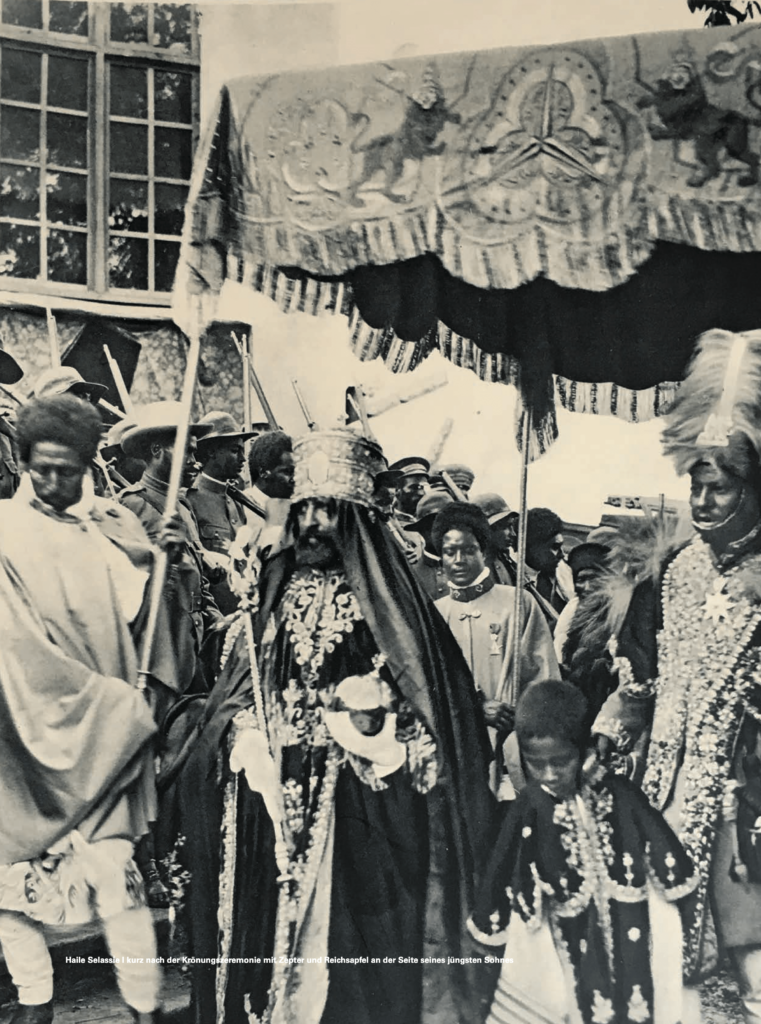
Contemporary gender neutrality and inclusion seem justified to me in light of Haile Selassie’s work. According to the Ethiopian historian Zewde Retta, Haile Selassie’s expressly desired double coronation with Empress Menen Asfaw on 2nd of November 1930 is just one of many indications of this, albeit a particularly important one in symbolic terms.
Haile Selassie’s words can hardly be surpassed in terms of the clarity, distinctness and elegance of the overall argument. It is by no means a coincidence that this very Haile Selassie speech was recited (in part) by Bob Marley in the song ”War” and set to reggae music. Perhaps that’s why some people call it a ”war speech,” although it was the exact opposite, namely a peace speech. This is evidenced by the fact that the word war only appears once in it, while ”peace” is mentioned a total of 23 times. Moreover, the single mention of war refers to a nuclear war to be avoided by all means and is not used as a threat.
It is worth knowing more than just the short excerpt selected by Bob Marley, which refers to the founding meeting of the Organisation of African Unity in Addis Ababa in May 1963. The entire speech achieves something that many contemporary anti-racist discourses seem to fail at: attacking the construction of ”races” as factors of separation, oppression and exploitation and at the same time calling for the indispensable further development into a single human race. This becomes clear in numerous passages, perhaps especially in its three glorious final sentences:
”We must become something we have never been and for which our education and experience and environment have ill-prepared us. We must become bigger than we have been: more courageous, greater in spirit, larger in outlook. We must become members of a new race, overcoming petty prejudice, owing our ultimate allegiance not to nations but to our fellow men within the human community.”
”Until that day, the African continent will not know peace. We Africans will fight, if necessary, and we know that we shall win, as we are confident in the victory of good over evil.”
A Paradox?
In it, Haile Selassie expresses that lasting peace requires overcoming the (false) foundations of separation. This leads to the conclusion that the reciprocal (essentialist) attribution of identities not only falls short in dismantling stereotypes, but actually renews and reinforces them. Even the most radical Livity of Rastafari in a militant sense – embodied in the Nyahbinghi Theocracy Order – has accordingly extended the formula ”Death to the white oppressors” derived from the African liberation struggle to ”Death to all Black and White Downpressors.” Many Reasonings see this as a reference to the imperative of impartiality, which goes back to Haile Selassie. His formula – also continuously repeated in reggae – is: ”I and I no partial!”
Equal Rights and Justice therefore functions as a double-edged sword. It unfolds its cutting power not only against an enemy based on arbitrary constructions such as ”race,” nation, ”gender,” class, origin, etc., but against all forms of inequality (arbitrarily) based on these constructions. As a demand, it unites Rastafarians worldwide just as much as the personality of Haile Selassie. Jah T. gave me an initial idea of this during my first visit to his record shop, which by no means coincidentally ended with the purchase of my very first reggae album: Peter Toshs’ ”Equal Rights” (which ultimately ”converted” me from a Rolling Stones fan to reggae and Rastafari).
Haile Selassie has lit a torch that a global reggae community should not let anyone blow out. It burns for the fight for equality against the still unconquered inequality – for (global) justice against the hydra of racially or otherwise justified injustices. In an interview available on YouTube (H.I.M. Haile Sellassie I squashes the skin color argument), which was conducted around the time of his appearance before the UN General Assembly in New York in 1963, Haile Selassie found unmistakable words for this. They are the perfect closing words:
”I must say that black and white, as forms of speech, and as a means of judging mankind, should be eliminated from human society. Human beings are precisely the same whatever color, race, creed or national origin they may be.”
Epilogue
The fact that these words still seem like a distant utopia almost 60 years later is not only a devastating finding, but also a task for all future generations. In any case, I believe that not allowing ourselves to be divided along skin color or other identity lines is an indispensable prerequisite for success – not least in Ethiopia itself, where a civil war is currently brewing between the Tigray People’s Liberation Front and the national army. In any case, Rastafari and reggae have been carrying the torch since 1963.
Werner Zips is the editor of the book ”Rastafari: A Universal Philosophy in the Third Millenium” (2010) and author of ”Hail Di Riddim” (2015).

Pingback: Haile Selassie I – Earth’s Rightful Ruler (Part 2) - riddim Mag
Pingback: Haile Selassie I – Everliving (Part 3) - riddim Mag