
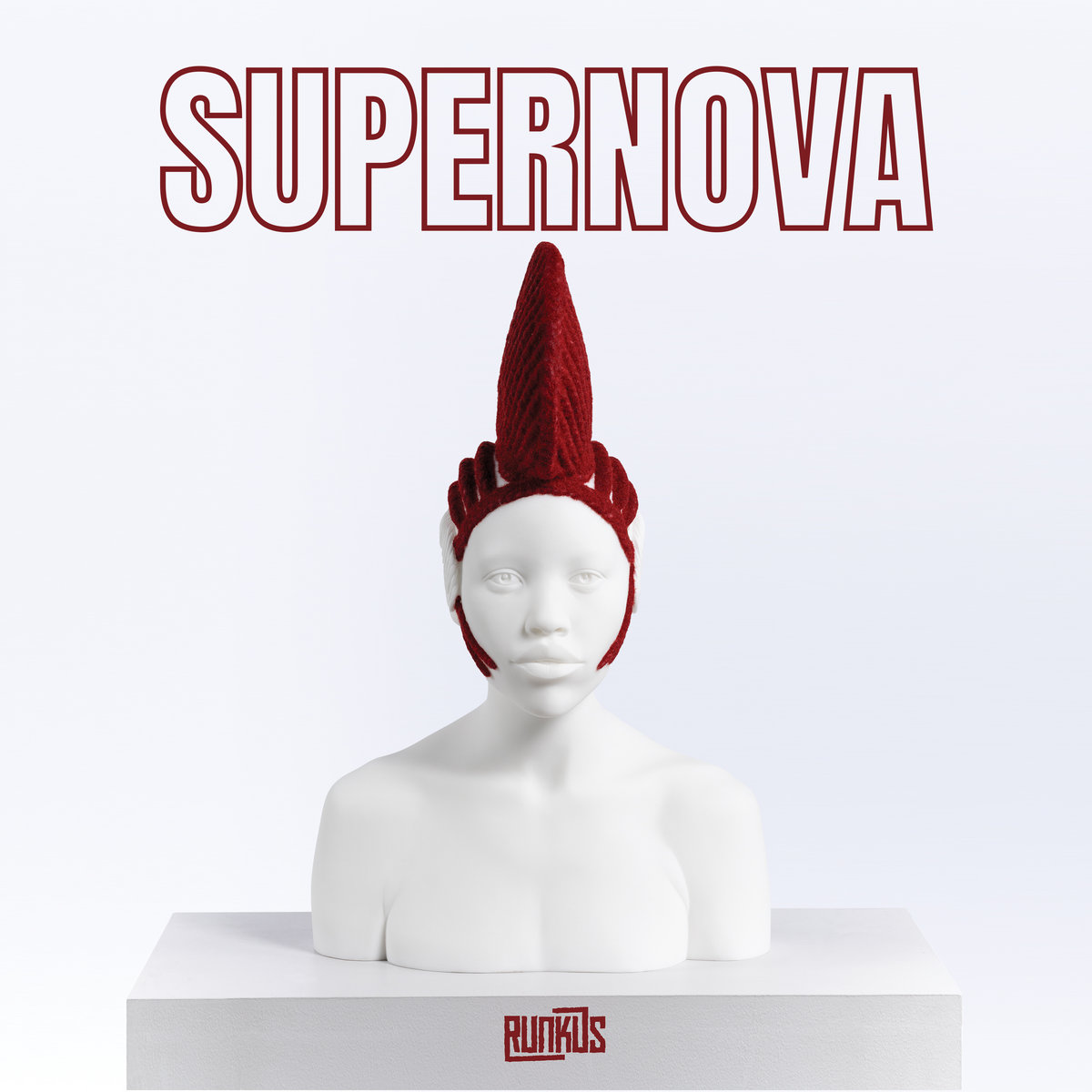
Runkus – Supernova
Easy Star Records (Digital & Vinyl)
Text: Davide Bortot
The first time Runkus caught my ear was in 2015, riding a ska riddim by Munich-based producers Moritz von Dorff and Benjamin Zecher of Oneness Records. I followed the label mostly out of hometown loyalty, and ”Move Yuh Feet” honestly hadn’t done much for me. But the flow of this guy was something else entirely: somehow 80s, yet completely his own and fresh.
Five years later, during one of those godforsaken pandemic streams that somehow passed for real life back then, Jugglerz dropped a song called ”Money” over the ”Brik Pan Brik” instrumental. I can still hear how Shotta Paul rolls the R in the artist’s name: Rrrrrrunkus. The tune underneath I remember just as well. Rather than radical individualism, Rrrrrrunkus was pitching community and abundance as a survival strategy. ”The tune was clearly conceived as a response to Skillibeng and the zeitgeist – not a challenge, not a lecture, just an alternative vision stated with complete certainty.
Two years after that, a lovers tune with Ky-Mani Marley showed up in my Release Radar. ”GOODLOVE” took me straight back to the best Marley moments of the ”Chant Down Babylon” era. Partly Ky-Mani’s voice, obviously – but just as much Runkus’ particular gift for carrying the weight of Jamaican music history on his shoulders like it’s nothing: historically grounded, sure, but with exactly the right amount of irreverence you need to push things forward.
This Runkus: serious talent, lots of juxtapositions, even more stories.
So why dust off mildly thrilling anecdotes from back in the day? Because all of the above – talent, juxtapositions, stories – applies just as well to Runkus’ new album, which was finally released last Friday. ”SUPERNOVA” is his fourth LP, and it feels like a debut: the first coherent body of work that unmistakably carries his vision, even though, much like the ”OUT:SIDE” project with Toddla T in 2022 or his work on Royal Blu’s album with the G.wav collective last year, it’s shaped by collaboration and exchange. It’s classic Runkus – a contradiction that just doesn’t feel like one, more like everything here slots into place through some deeper understanding of the world’s inner workings.
”SUPERNOVA” was made in collaboration with the artist Tavares Strachan, who until now has moved primarily through the world of museums and academic discourse. Most recently, he exhibited at the Kunsthalle Mannheim, with Runkus coming on board to select and perform music for the show. Now the shared journey has taken a new shape. Strachan’s involvement in ”SUPERNOVA” is theoretical as much as spiritual. Some of his works provided direct source material for songs; beyond that he served as an intellectual sparring partner. ”Tavares is kind of a creative guide to me,” Runkus explains in our RIDDIM interview. ”He pushes me.” Specifically, the album opens and closes with Strachan in very concrete terms: excerpts from an artist talk exploring the power of art, and the violence that is inherent to it by definition. A conversation between a conceptual artist and a curator as an intro – and then, as the opening track, a classic retro dancehall tune (a deceptively classic retro dancehall tune, that much of a spoiler feels fair) that views the current state of the world through the lens of sound system culture. That’s Runkus’ take on music and his worldview in a nutshell: everything connects to everything else.
A few examples of that approach to interconnectivity. Following the cinematic opening of the title track, the album is bookended by ”SHEEP” and ”THE BOY WHO CRIED WOLF” – two tunes that trace an arc from Aesop to Peter Tosh, from a deeply poetic speech by the Wailers legend to some pretty hard-nosed reflections on resisting the postcolonial instruments of oppression. ”THE BOY WHO CRIED WOLF” itself runs just over eight minutes across two beats, drawing a line from tribal percussion from South Africa through ”Jesus Walks”-type neo-gospel to globalized dancehall in the current Y2K revival mode – because in music history too, everything connects, once you’re willing to follow the (Black) roots across different pop eras. ”LAST NIGHT”? A dancehall fling story that sounds like disco-funk and R&B and tips its hat to the dance classic ”Last Night A DJ Saved My Life”. ”EGO DEATH”? A seemingly endless stream-of-consciousness rap that runs through landmarks of Jamaican music history – including Runkus’ father, the singer Determine, who passed from cancer in 2025 – while flipping familiar gun-and-killing metaphors in ways you don’t see coming. ”LIFE OVER DEATH”? Quotes G‑Unit and New Jack Swing and samples its way around the world. ”PLEASE DON’T COME TO MARS”? A masterclass in artistic and financial self-determination, with zero manosphere nonsense. ”3310”? A song about the legendary Nokia cellie. But also: a dembow homage, a case for the social and economic value of dancehall, and a view of the many of Jamaican society through the lens of the one thing that genuinely brought everyone together for a while.
Sounds like a lot?
It is.
Sometimes, in this swirl of ideas and references, Runkus loses me. Suggesting that Israel and Palestine settle their conflict via sound clash, or framing Donald Trump as just another garden-variety, horny clown (”And me know seh Donald Trump him love punany bad”) – that reads as a little too easy, a little too close to the perennially comfortable idea that the defining crises of our time can simply be basslined away by the only good system there is, because ”they” are all the same anyway. And when Runkus and his co-producer reach for Cuban horns and rock riffs on ”Every Ghetto Youth is A Star” to land an undeniably worthy message, the skipping itch kicks in. But honestly, how does my personal taste matter against the sheer power this album delivers? Isn’t it far more significant that the co-producer in question is Runkus’ brother Zaire-Zidane, and that the two are stepping out together in this form for the first time, just over a year after the death of their father? Doesn’t what Sean Paul – the album’s only featured guest – puts down on ”SURE AS THE SUN” matter much more: that you can kill however many messengers you want, but never the message itself? And doesn’t the thought that Tavares Strachan shares at the very end of the album just about cover it? ”To be frustrated by an artist is a good thing. Irritation is helpful.” Feel free to draw your own conclusions.
In any case, one more line from that outro stays. ”There is a certain bigness of imagination that is scalable for all of us – if we just allow ourselves to find it.” The speaker is curator and interviewer Paul Holdengräber, addressing Tavares Strachan. But his words could just as easily be the takeaway from listening to this remarkable album: those who allow themselves to think, believe and feel big – for them, much becomes possible.