
Why does AI-generated music feel problematic to us? Can I appreciate and value music if there is no human creator behind it? Is the aversion to AI-generated music nothing more than wounded human pride? Our author, René Wynands, asks himself these and other questions after unwittingly reviewing an album that was likely generated by AI, thereby sparking a fundamental debate.
Text: René Wynands
In the last printed issue of RIDDIM, I reviewed Haris Pilton’s latest album, ”Think Dubby,” which I actually enjoyed quite a bit. One review among the thousands I’ve written in my life. And yet this one triggered quite a controversy on Dubblog. I hadn’t realized that Haris Pilton had apparently used artificial intelligence in the production of his dubs. At least, that accusation was raised – though never proven. On the other hand, Haris never clearly denied it either, so it’s fair to assume AI was indeed involved.
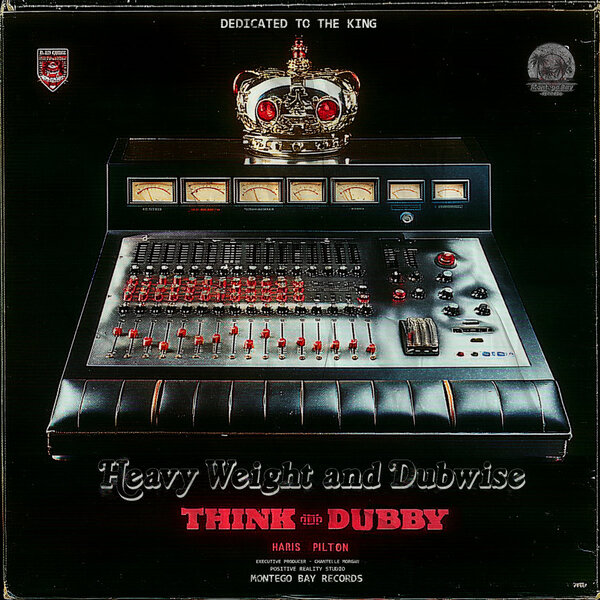
Fortunately, the dispute was less about me and my review. Those merely served as the catalyst for serious accusations directed at Haris Pilton himself. He was said to be deceiving the dub community and dishonoring our sacred genre.
While in some genres nobody really seems to care whether AI was involved in the production process, in dub it apparently makes a massive difference whether music is considered ”honest” or fraudulent.
I have to admit that I, too, was somewhat shocked and quietly began doubting my own dub competence. How could I not hear that the dubs were AI-generated? How did it escape me? To be fair, the quality of Pilton’s productions fluctuates quite heavily, and his oeuvre also feels stylistically inconsistent. Maybe that should have made me skeptical. Even ”Think Dubby” itself doesn’t feel entirely cohesive. There are brilliant tracks on it, but also weaker ones that fall out of line.
Only afterward did I start asking myself why it actually matters whether dub is AI-generated or ”handcrafted.” My motto has always been, borrowing from former German chancellor Helmut Kohl: ”What matters is what comes out in the end.” And I still stand by that. Ultimately, what matters is what we actually hear. A work is either good or bad regardless of how it came into existence, what technology was used, who created it, whether a lot or little money, time, or talent went into it. Information about the production may influence our perception and help us understand a work more deeply. But it changes nothing about the quality of the music itself, because the sound reaching our ears remains the same – regardless of what we know about it. So shouldn’t we be able to judge a piece of music without all that prior knowledge, based solely on what’s actually there: the pure music itself? Seen this way, it shouldn’t matter whether real musicians were involved, whether it was produced digitally in Logic Pro, whether samples were used, or whether the music was AI-generated. Right?
Strangely enough, it does matter. I don’t enjoy listening to AI music from Brighton Dub Club or Full Dub Riddims. Something inside me resists it – and apparently many other dub fans feel the same way. Why?
Attempted Explanation No. 1
One possible explanation is that AI-generated dubs are essentially a fraudulent rip-off of human musicians, because the AI was trained using the work of actual artists – without compensating them. This argument is frequently made by creatives across many disciplines: graphic designers, illustrators, photographers, copywriters, videographers, authors, and many others. These people invested huge amounts of time and effort into developing their skills, and now AI is taking their jobs away. Worse still, AI can only do this because it ”trained” itself on the works of those same creatives.
Legally, the issue boils down to whether AI companies unlawfully used copyrighted material to train their models. This is currently the subject of heated legal debates, and we’ll probably soon find out whether OpenAI, Google, Anthropic and the others will eventually have to compensate creators through some form of collective licensing system.
The general principle of learning from the works of others is not disgraceful in itself, though. After all, what exactly is AI doing differently from human students learning from the works of great masters? Isn’t it standard educational practice to develop one’s skills by studying the works of others? Fundamentally, we train ourselves exactly like AI does: by observing, analyzing, and studying the works of others. Aside from the fact that humans learn far more efficiently, it’s basically the same process. However – and this is a crucial difference – we paid for museum tickets, books, or Spotify subscriptions beforehand. Indirectly, we compensated creatives for allowing us to study their work.
Our use of others’ works becomes even clearer in sampling, collages, or quotations. Here, copying occurs quite literally – and yet it’s widely accepted. Cleverly chosen samples are often praised, smart references appreciated, and collages recognized as independent works of art. So why the hell do we have a problem with AI-generated dub?
Isn’t it standard educational practice to develop one’s skills by studying the works of others? Fundamentally, we train ourselves exactly like AI does: by observing, analyzing, and studying the works of others. […] However – and this is a crucial difference – we paid for museum tickets, books, or Spotify subscriptions beforehand. Indirectly, we compensated creatives for allowing us to study their work.
Attempted Explanation No. 2
Maybe it’s wounded vanity because nobody actually made the effort to create the music I devote my time to listening to carefully. Can I enjoy music if there’s no artist behind it who actually cares about me as a listener? If there’s nobody trying to please me, nobody making an effort to give me enjoyment, nobody who, ideally, has something to say to me?
In short: Can I appreciate and value music if there is no human creator behind it?
Strangely enough, this isn’t a problem with idyllic landscapes. There’s no human creator behind those either, and yet we deeply enjoy and appreciate them. The same goes for other natural beauties. Some plants and animals fascinate us immensely, despite not being the work of any artist. Why should music, painting, or film be different? Perhaps a truly advanced AI will one day compose nothing but great music. All killer, no filler. What exactly would be wrong with that?
Attempted Explanation No. 3
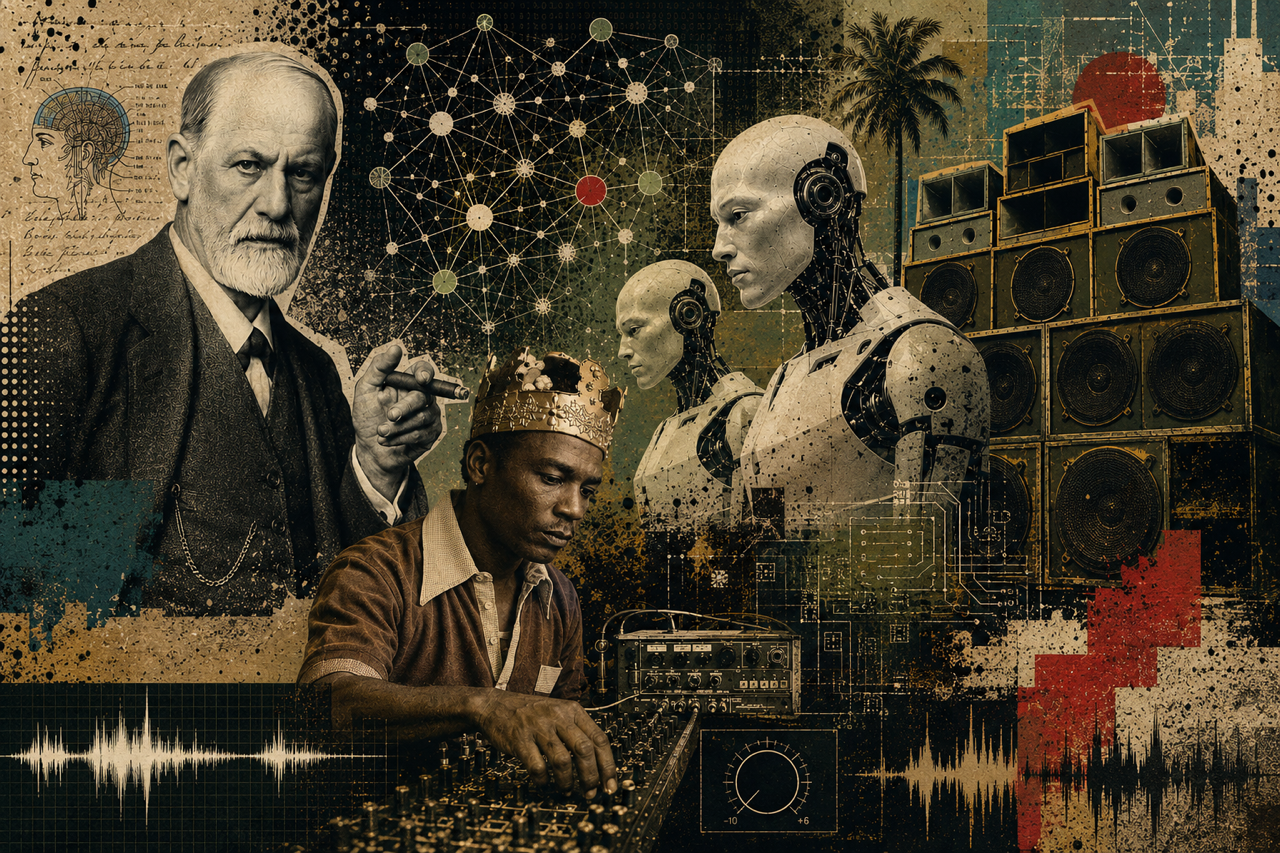
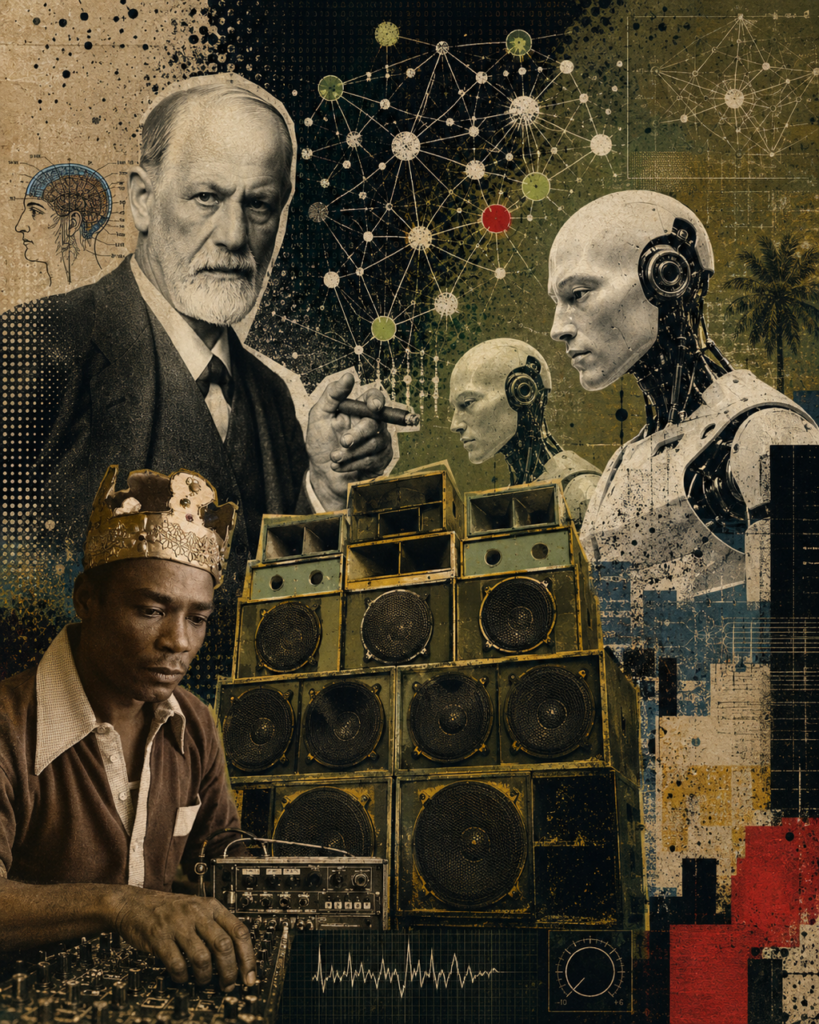
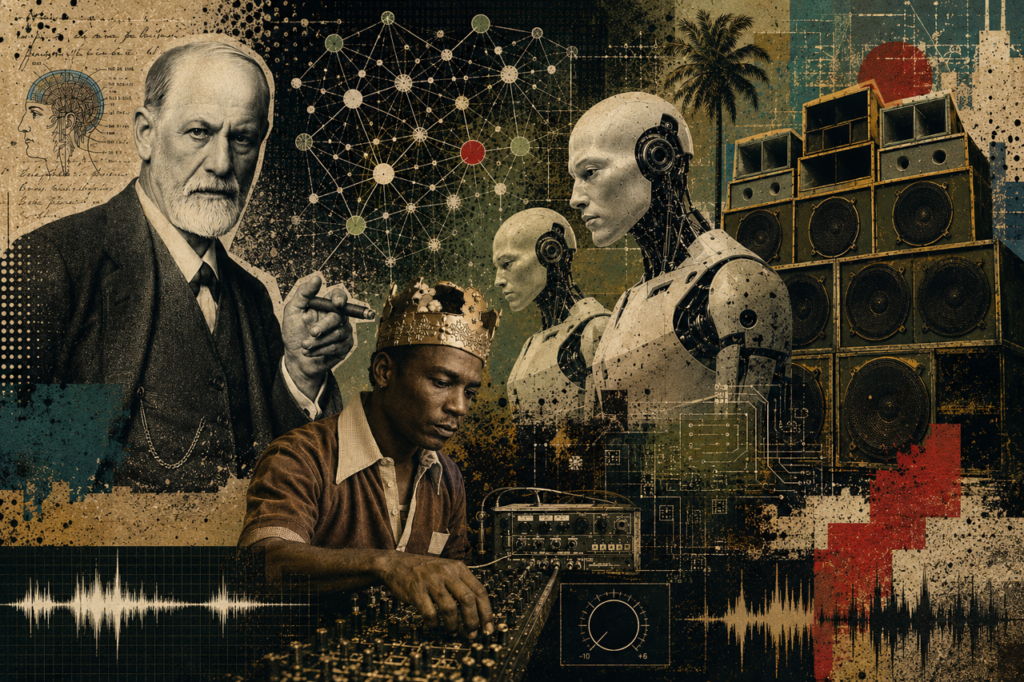
Maybe we need to dig deeper into the psyche of modern Western humanity to understand the discomfort AI music and AI art provoke in us. So let’s start with Sigmund Freud.
In his 1917 essay ”A Difficulty in the Path of Psycho-Analysis,” Freud described the resistance his theory encountered. Like every scientific breakthrough, psychoanalysis had to fight established ways of thinking – not least because, according to Freud, ”powerful feelings of humanity had been injured.”
Freud identified three major narcissistic wounds to mankind: the cosmological wound inflicted by Copernicus, who removed humanity from the center of the universe; the biological wound inflicted by Darwin, who placed humans among animals; and finally the psychological wound inflicted by Freud himself, who declared that the ego is ”not master in its own house.”
Since then, more wounds have followed. Neurobiology has severely shaken the old separation between body and mind. The ”self,” which we like to understand as an autonomous entity, increasingly appears to be merely a function of a body governed by chemistry, biology, instincts, routines, and unconscious processes.
And now comes the latest insult: intelligence and creativity apparently no longer belong exclusively to humans. Machines write texts, paint images, compose music, design visuals, generate voices, imitate styles, and solve problems that until recently we believed required talent, education, experience, or at least an emotionally sensitive inner life.
Of course that hurts. It hurts because it takes away yet another bastion where humanity had comfortably settled itself. If a machine can suddenly generate a dub album that, at least on first listen, actually works, then it challenges not only the machine itself but also our entire understanding of what human creativity really is. Who can fully enjoy a work that simultaneously raises the suspicion that some of our most sacred distinctions between humans and machines may not be as stable as we thought?
If a machine can suddenly generate a dub album that, at least on first listen, actually works, then it challenges not only the machine itself but also our entire understanding of what human creativity really is.
But even this explanation isn’t sufficient. Resistance to AI music isn’t merely wounded pride. Nor is it simply the offended reaction of a species discovering it now has competition. Many objections to AI are much more concrete. Musicians, producers, graphic designers, writers, and other creatives fear not only that machines may become better than they are. They fear that platforms, labels, streaming services, and content farms will use AI to devalue human labor, suppress compensation, bypass rights, and transform culture into endlessly available, infinitely replaceable mood sludge.
That’s not merely narcissistic injury – it’s a real question of power. Who owns the training data? Who profits from the models? Who gets replaced, who gets paid, who remains visible? Who can still afford to treat human creativity as something valuable when synthetic alternatives are cheaper, faster, and infinitely scalable?
In that sense, our discomfort with AI music may actually be distrust toward the economic systems in which this music is created and distributed. Perhaps our resistance isn’t directed solely at the machine itself, but at the world producing it – a world AI will likely make even more efficient, smoother, and more ruthless.
Still, the psychological wound remains an important part of the issue. Because even if all legal questions were resolved, even if musicians were fairly compensated, even if AI-generated music were transparently labeled, some discomfort would probably remain. The idea that creativity can emerge from probabilities, patterns, and context windows – without experience, vulnerability, boredom, longing, or a relationship to the world – contradicts our deeply ingrained understanding of art. We want to imagine someone behind a work: a subject, an intention, a body, a life. AI may deliver a result without providing that story. And that is precisely where its provocation lies.
Attempted Explanation No. 4
Which brings us to the issue of the artist’s personality.
For thousands of years, we humans have been conditioned to believe that cultural and artistic works originate from gifted individuals. While artists were once considered craftsmen, the 18th century gave rise to the idea of the artistic genius. To this day, we still think of the artist as an original, creative individual who brings forth something new from within. This idea reached its peak during Romanticism around 1800, when the artist became an almost visionary figure with special access to truth, nature, or the absolute. Art appeared to be the expression of some unique inner force.
This ”artist myth” still exists today – albeit in weakened form – and continues shaping how we view art and culture. Even though the image of the lone genius has increasingly become intertwined with society, markets, technology, and collaboration, we still find it extremely difficult to imagine art existing without a human creator.
And there’s more. For centuries, art primarily served religion. Its purpose was to mythologize religious narratives. Art and religion have therefore always been deeply connected. As modernity gradually pushed this function into the background, art, in the course of its ”liberation,” began mythologizing itself instead – elevating and glorifying itself. Art effectively became a religion of its own, and artists its priests.
So if we now attempt to throw this entire conception of art and artists overboard because of AI, we must fight against centuries of ingrained predispositions: the tendency to believe in higher orders, authorities, systems of meaning, and charismatic leaders – whether priests, rulers, or artists. That belief provided us with meaning, protection, order, belonging, and relief for centuries. And now we’re suddenly supposed to abandon it because thinking machines exist? How are we supposed to question all of this simply because we’re learning that art may no longer require its traditional authorities?
Attempted Explanation No. 5
And then there’s yet another painful loss: the loss of the artwork itself.
We vinyl collectors already struggled enormously with letting go of physical, tangible representations of music and buying MP3 files from the iTunes Store instead – even though we still ”owned” those files on our hard drives. Streaming took even that ownership away from us. Music became immaterial. Yet at least the work itself still existed as an album or a song – the smallest unit in our Spotify library.
But now imagine what things might look like in five years, when Spotify’s AI no longer needs to pre-produce songs – as it still largely does now – but can generate them ”on the fly,” in real time. Imagine that the Spotify stream no longer consists mostly of pre-produced AI tracks but instead becomes an endless flow of real-time generated music designed precisely around our tastes.
In that scenario, music would exist only in the moment of its creation. The virtual music collection would disappear. And along with the artist, the work itself would evaporate too.
A dystopia?
Then let’s bookmark this article and read it again in five years. I’m curious myself what state our favorite music will be in by then.
In any case – and I think this should be clear by now – I do not believe AI music, and especially AI-generated dub, is inherently evil. Rather, it is our own psychological makeup – narcissistic wounds, our faith in art, our fear of loss – that prevents us from recognizing and embracing the possible qualities of AI music.
I have to admit: even writing this is difficult for me.
Still: let’s look at current and future music production without prejudice. Let’s listen carefully and judge music solely by what reaches our ears. ”None of us can stop the time.”
Or can we?
Attempted Reconciliation
And perhaps this is where the real contradiction lies.
On the one hand, the sound itself remains the same. A bassline doesn’t become worse simply because I later discover no bassist played it. An echo doesn’t measurably lose depth because it came from an algorithm. The reverb chamber doesn’t physically collapse once I learn that nobody opened it by hand on a mixing desk. What reaches my ears remains identical.
And yet we apparently never hear music as pure sound alone. We always hear it as the trace of a practice, an attitude, a scene, a history.
Especially in dub, this is difficult to ignore. Dub is not merely a sonic aesthetic of bass, reverb, echo, dropouts, and delay loops. Dub is studio craftsmanship, sound system culture, improvisation, manipulation of material, social background, physicality, and spatial awareness. Dub lives from someone taking existing material, dismantling it, reassembling it, dragging it into depth, making it disappear and reappear. Ideally, we don’t just hear a result – we hear a process: hands on the mixing desk, decisions made in the moment, courage to leave gaps, a willingness to take risks, sometimes even the charming imperfection of an idea that feels alive precisely because of its flaws.
If AI dub merely imitates this entire web of relationships without actually participating in it, then perhaps something is missing that cannot necessarily be measured in the frequency spectrum. Everything may sound ”correct”: the bass warm, the snare dry, the delay nicely offset, the melodica entering at exactly the right moment. And yet something feels absent. Not because the machine selected the wrong sound, but because the sound no longer carries a story – or at least not one I can believe in.
Dub, especially, was always more than a sound. It was a method, a place, a worldview. And perhaps that is precisely why AI-generated dub affects us more deeply than AI elevator music. It doesn’t merely imitate a surface – it imitates a cultural practice that, for many of us, carries far more significance than just a few pretty echo effects.
The deficiency, then, lies not in the sound itself, but in the meaning of what is heard. It’s not an acoustic loss, but a cultural one.
That makes things more complicated than I’d like. Because when I say, ”Only what comes out in the end matters,” I reduce music to its audible result. As an antidote to prejudice, that’s useful. But perhaps it’s also insufficient. Perhaps a musical work consists not only of vibrations in the air, but also of the relationships condensed within it: between musicians, technology, tradition, scene, audience, history, and the present moment.
Dub, especially, was always more than a sound. It was a method, a place, a worldview. And perhaps that is precisely why AI-generated dub affects us more deeply than AI elevator music. It doesn’t merely imitate a surface – it imitates a cultural practice that, for many of us, carries far more significance than just a few pretty echo effects.
So yes, as you can see, I’m torn apart by contradictions.
Let’s have a discourse about these questions. One thing remains certain: we will see what comes. I firmly believe reggae and dub are such powerful musical ideas that they will retain their strength and relevance even under changing production conditions. But that won’t happen automatically. If dub is to remain more than just a nicely reverberating stylistic surface, then we need to continue debating what actually defines it.
Perhaps in the end, what matters really is ”what comes out in the end.” But what comes out is never just sound. It is also history, attitude, origin, practice, promise, deception, longing – and sometimes a wound we first have to understand before we can overcome it.
By the way: Haris Pilton’s ”Think Dubby, Vol. 2” was recently released. I like it.