

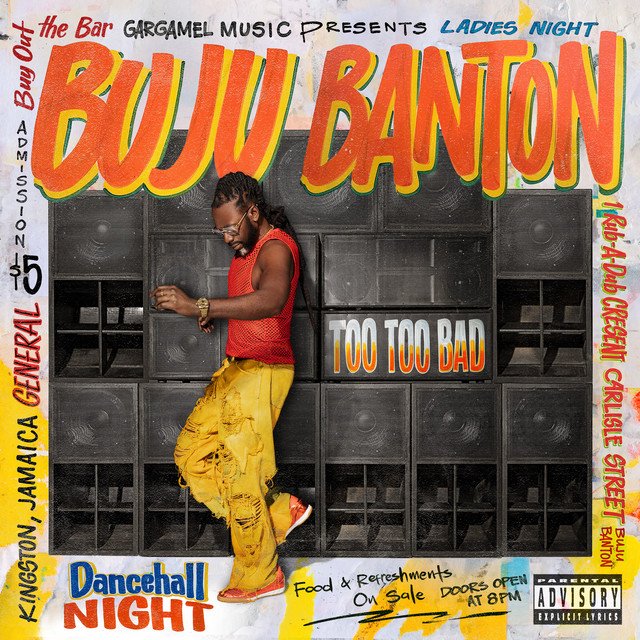
Buju Banton – Too Too Bad
Gargamel Music/VP Records
Text: Davide Bortot
The story of this album starts, as everything tends to do these days, with a video on the internet. In the video, a well-built man talks about fucking. He’s standing by a pool. We have been here before. What you might want to add: the well-built man is clearly past 50. What you might also want to add: this man is not some manosphere bro spouting alpha nonsense into his front camera, but one of the most important dancehall artists of all time in his element. It’s Buju Banton.
The video in question is a freestyle of sorts on the ”WYFL” riddim – the monster beat that, over the past nine or so months, finally brought back jugglings to the big stage. It’s not just the format, though, that exudes a throwback vibe. Buju’s performance itself feels so much of another era that you find yourself wondering which ”Ragga Ragga Ragga” it’s on. In reality of course, the song, ”X Rated,” features on no compilation. It’s part of Buju’s new album, ”Too Too Bad” – an album which, that much is safe to say, runs that same line across its entire duration. It’s the old Buju: with fresh energy, but like in the glory days, when he first burst onto the scene with tunes like ”Stamina Daddy” or ”Love Me Browning,” or like 2006 when Buju already returned to his hardcore roots once. After ”Too Bad”, now ”Too Too Bad”: ruff and tuff and X‑Rated, even at 53.

The idea for this album came long before ”WYFL.” But Buju sure was happy to ride the wave and take the challenge. In the end, everyone won. With Buju and fellow legacy artists Anthony B and Wayne Wonder, the whole thing picked up even more weight. And in return, DJ MAC and the internet built Buju a perfect bridge from his first prime into the present – one he walks with maximum conviction on ”Too Too Bad.” The project doesn’t even make an attempt to break up the vintage feel or adapt it to current convention. Everything is textbook early Buju, from the title, to the cover artwork by renowned sign painter Rushane ”Bug” Drummond, down to the songs themselves.
Content-wise, ”Too Too Bad” is about sex. There’s the occasional mention of falling in love, and here and there Buju makes an anatomical observation. But first and foremost, the album is about what you can do with those body parts. Sex. Some people, including myself, might find that uncomfortable at times. Middle-aged men talking about shining pum pum and truckloads of women as readily available: oh well. Maybe that’s just Central European uptightness, though, and ultimately regressive. Good for him he’s still pulling it off, isn’t it? You also have to give Buju credit for staying away from Gen Z slang and the current wave of ultra-explicit XXX lyrics. Positions are rather mentioned than described in detail. The Gargamel keeps it to a single X and sticks to Unc compliments of the ”you look good and you smell right” variety. Ultimately, all of this doesn’t matter much, anyways. Buju has never been one to care about other people’s feelings, let alone critics’. If anything, it’s consistently pushed him rather than slowed him down over the course of his now 35-year career. Here, too, he follows through without compromise.
That applies to the album’s sonic aesthetic too. ”Too Too Bad” is a rich gift for everyone who remembers Buju’s early phase as a young, unruly dancehall warrior with affection and generally prefers things the way they used to be. Parts of the record draw explicitly on classics of Jamaican music history. The opener ”We Nuh Play,” for example, is built on the ”Diseases” riddim, lightly tightened up by Jermaine Reid, who already collaborated closely with Buju on the ”Upside Down” album. The single ”Butterflies” sits on the ”Real Rock”. Another designated hit, ”Wild Woman” with DJ Khaled, samples Notch’s ”Nuttin Nuh Go Suh” along with Tony Kelly’s ”Buy Out” riddim. Sixties, eighties, noughties: the Gargamel barrels through the history of reggae and dancehall in decisive two-decade jumps. The all new instrumentals recall the past too. Take ”FAFO”: even the mix makes it sound like it was pulled straight off a bootleg Tony Touch tape from 1998. All that’s missing is the song cutting out mid-track for you to flip the cassette. Otherwise: the real deal.
What makes the time travel feel even more genuine is that Buju’s notorious boom voice is fully intact on ”Too Too Bad” – maybe rougher and more voluminous than ever. Watching and hearing him spit in his performances for the Colors platform, it’s hard to believe he’s been doing this job for three and a half decades. More precise, more powerful, more passionate is hard to imagine. Writing big tunes is another thing Buju still does like almost nobody else out there. ”House Call” or ”Good Pum Pum” – one of two contributions from Suku Ward of Ward 21, by the way – go straight to the Buju classics playlist. ”Butterflies” and the closing ”Power” with Gramps Morgan also excel, with zero nostalgia bonus required.
The best new Buju song, however, didn’t make the album. ”Hello,” his collaboration with R&B singer Masego, shows what a modern Buju dancehall album could have sounded like: an imaginative dunk-dunk groove meets a clever Y2K sample and a vocal contrast that has always suited Buju well – and that, for my taste, shows up a little too rarely on the album. The flip side of ”Too Too Bad’s” conviction is a certain predictability. ”Satisfy Me” with Ari Lennox and the (beautiful) ballad ”Be Good,” co-written by internationally acclaimed songwriters Jeff Gitelman and Theron Thomas, are careful attempts at broadening the stylistic palette. But for the most part, it’s straight-up hardcore dancehall – which Buju represents authentically on the biggest stages in entertainment, from Jimmy Fallon to Times Square. That alone, as a dancehall aficionado, you have to love regardless of how you feel about these kinds of retro rewind endeavors: Buju is – and, crucially, remains – one of the all-time greats of this culture.